Rebar vs. Wire Mesh vs. Fiber for Concrete Slabs | Goodyear, AZ
Choosing the right reinforcement is one of the most important decisions when planning a concrete slab in Goodyear, Arizona. Concrete performs extremely well under compression, but reinforcement can help a slab manage tensile stresses, control cracking, and perform as intended over time.
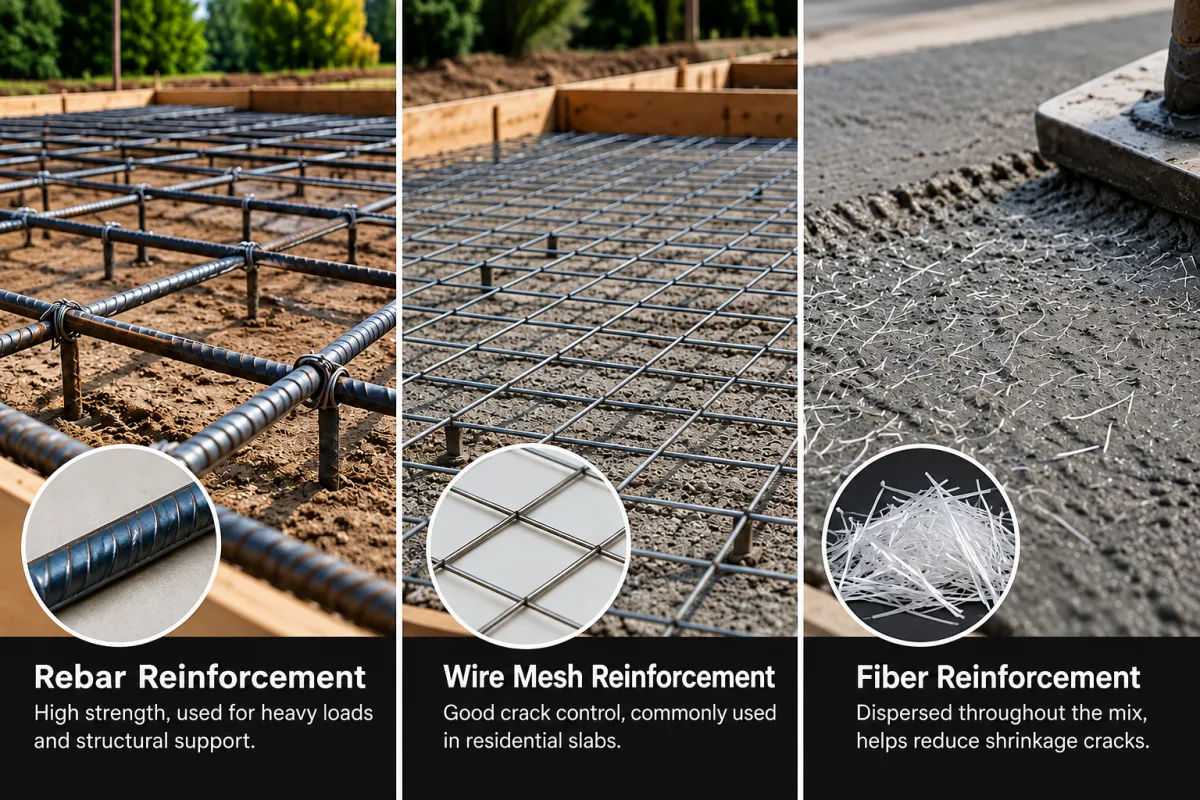
Three common options are rebar, welded wire reinforcement (often called wire mesh), and fiber reinforcement. They are not interchangeable, and there is no single reinforcement option that is automatically best for every project. A residential patio, garage floor, RV pad, warehouse floor, equipment pad, and structural foundation can all have different requirements. The appropriate reinforcement depends on factors such as slab thickness, expected loads, subgrade conditions, joint layout, engineering requirements, and intended use.
At Ares & Eros Contracting, concrete slab construction is approached as a complete system from site and subgrade preparation through reinforcement, placement, finishing, joints, and curing. The company provides residential, commercial, and industrial concrete services throughout Arizona, including Goodyear.
Why Do Concrete Slabs Need Reinforcement?
Concrete naturally experiences stresses as it cures and as temperature, moisture, loading, and supporting soil conditions change. Cracking can occur even in a properly designed and installed slab. Reinforcement does not necessarily prevent every crack. Depending on the system, it can help control crack widths, distribute stresses, improve post-crack behavior, or provide structural capacity. That distinction is important. Reinforcement intended primarily for shrinkage or temperature crack control should not automatically be treated as a replacement for structural reinforcing steel specified by an engineer.
For engineered slabs and foundations, contractors should follow the structural drawings and project specifications rather than changing reinforcement solely because another option is less expensive or easier to install. For more information about the complete installation process, see Ares & Eros Contracting's Concrete Slab Installation in Arizona guide.
Rebar for Concrete Slabs
Rebar, short for reinforcing bar, is one of the most familiar forms of concrete reinforcement. Steel bars are installed in a planned pattern before the concrete is placed. Depending on the project, the structural design may specify bar size, spacing, location, laps, cover, and other installation details.
Where Is Rebar Commonly Used?
Rebar may be appropriate for:
Structural slabs and foundations
Garage and vehicle slabs
RV parking areas
Equipment and machinery pads
Commercial and industrial floors
Thickened slab edges
Footings and grade beams
Slabs subject to heavier or concentrated loads
One of the major advantages of rebar is that engineers can design the reinforcement around the forces the concrete is expected to resist.
Rebar Placement Matters
Installing rebar is not simply a matter of laying steel on the ground before the concrete truck arrives. The reinforcement must be placed and supported at the location required by the project design. Chairs or other approved supports may be used to maintain the required position and concrete cover.
Ares & Eros Contracting's slab-on-grade process, for example, includes coordination with structural drawings, assembly of the reinforcement, proper support, and a pre-pour review of reinforcement and other slab components. For engineered foundation work, see Slab-on-Grade Foundation Construction in Arizona.
Wire Mesh for Concrete Slabs
Welded wire reinforcement consists of intersecting steel wires welded together into a grid. Different wire sizes and spacing configurations are available, and reinforcement may be supplied in sheets or rolls depending on the product and application. Wire reinforcement can be used to distribute stresses and assist with crack control in certain slab-on-ground applications.
Where Can Wire Mesh Be Used?
Depending on the slab design, welded wire reinforcement may be considered for applications such as:
Residential flatwork
Garage floors
Walkways
Patios
Light-duty slabs
Certain commercial slab-on-ground applications
Wire reinforcement provides a relatively uniform reinforcing pattern across the slab when it is specified and installed correctly.
Why Wire Mesh Placement Is Important
Just like rebar, welded wire reinforcement needs to remain in its specified position during the pour. If reinforcement that is supposed to be located within the slab ends up lying directly on the subgrade, it may not perform as the design intended. Proper support and placement therefore matter just as much as choosing the reinforcement itself.
For example, Ares & Eros Contracting's Concrete Patio Construction in Arizona process describes the use of rebar or wire mesh based on project requirements and emphasizes positioning reinforcement at the correct height within the slab.
Fiber Reinforcement for Concrete Slabs
Fiber reinforcement works differently from conventional reinforcing steel. Rather than installing bars or sheets before placement, fibers are incorporated into the concrete mixture and distributed throughout the concrete.
Several categories of fibers are available, including synthetic microfibers, macro-synthetic fibers, steel fibers, and specialty products. Their properties and intended applications can differ substantially.
Where Is Fiber Reinforcement Used?
Depending on the product, dosage, slab design, and engineering requirements, fiber reinforcement may be used in:
Residential slabs
Exterior flatwork
Commercial floors
Industrial slabs
Pavements
Overlays
Specialty concrete applications
Certain fibers can help manage plastic shrinkage cracking, while other engineered fiber systems can provide additional post-crack performance.
Ares & Eros Contracting's concrete slab installation process includes fiber reinforcement for industrial slabs where specified, while rebar or welded wire reinforcement is used where required by the slab design.
Can Fiber Replace Rebar?
Sometimes this question is oversimplified. Not every fiber product is a replacement for rebar. Microfibers intended primarily to control plastic shrinkage cracking, for example, should not automatically be considered a substitute for structural reinforcing steel. Other engineered macro-synthetic or steel fiber systems may be designed for applications where they provide greater structural performance. Whether they can replace some conventional reinforcement depends on the particular product, dosage, engineering, loads, and slab design.
For that reason, a proposal that simply says "fiber reinforced concrete" does not provide enough information for an engineered project. Property owners and general contractors should understand what fiber is being proposed, the dosage, its intended function, and whether the system complies with the project's structural specifications.
Rebar vs. Wire Mesh vs. Fiber: Which Is Better?
There is no universal winner. Rebar is commonly used where substantial tensile or structural reinforcement is required and can be designed around specific structural demands. Welded wire reinforcement can provide distributed reinforcement across the slab and may be appropriate for crack-control and other slab-on-ground applications when properly specified and positioned. Fiber reinforcement distributes fibers throughout the concrete mixture and can provide specific crack-control or post-crack benefits depending on the fiber type and dosage.
Some projects may use more than one system. For example, a slab can contain conventional reinforcing steel while also using fibers when the design calls for each material to perform a different function.
The more useful question is therefore: What reinforcement system is appropriate for this slab's loads, supporting conditions, thickness, intended use, and engineering requirements?
Reinforcement Is Only Part of a Good Concrete Slab
One of the biggest mistakes when comparing concrete contractors is focusing entirely on whether they use rebar, wire mesh, or fiber. Reinforcement is only one part of the slab assembly.
A properly planned concrete slab may also require attention to:
Excavation and grading
Subgrade preparation
Aggregate base
Compaction
Drainage
Slab thickness
Concrete specifications
Vapor barriers where applicable
Reinforcement placement
Control and isolation joints
Concrete placement
Finishing
Curing
A heavily reinforced slab cannot automatically compensate for inadequate supporting conditions or poor construction practices.
Ares & Eros Contracting's published slab process includes reviewing plans, loads, and soil conditions before excavation; preparing and compacting the base; placing reinforcement; and following the pour with appropriate curing and protection. Learn more about the company's Arizona concrete slab installation process.
Goodyear's Arizona Climate Matters During Concrete Placement
Concrete construction in Goodyear also has to account for Arizona's hot, dry conditions. High temperatures, direct sunlight, wind, and low humidity can accelerate moisture loss from fresh concrete. That can make delivery scheduling, placement, finishing, crew coordination, and curing especially important during hot weather. Reinforcement does not eliminate the need for proper placement and curing.
A durable slab should be considered as a complete system: Subgrade + thickness + concrete mixture + reinforcement + joints + placement + finishing + curing.
Each part can affect how the finished concrete performs.
Reinforcement for Residential Concrete Slabs in Goodyear
For residential work, reinforcement should reflect how the slab will actually be used. A backyard patio supporting furniture and foot traffic does not necessarily have the same requirements as a garage carrying vehicles. An RV pad, workshop floor, driveway, home addition, or equipment pad may introduce different loads and construction requirements. Homeowners should tell their contractor exactly how they plan to use the slab rather than choosing reinforcement solely from a price comparison.
The contractor can then evaluate the project requirements and, when engineering is required, construct the slab according to the approved plans and specifications.
Reinforcement for Commercial and Industrial Slabs
Commercial and industrial concrete often requires a more detailed analysis. Forklifts, storage racks, machinery, commercial vehicles, and concentrated equipment loads can affect slab thickness, reinforcement, joint design, and the supporting base.
Projects may also involve:
Structural engineering
Geotechnical reports
Concrete testing
Vapor barriers
Dowels
Embeds
Thickened areas
Specific joint layouts
Elevation tolerances
Detailed placement sequencing
General contractors should therefore compare reinforcement proposals with the structural plans and project specifications instead of relying on residential rules of thumb. For projects involving engineered foundations and heavier structural requirements, see Structural Foundation Construction in Arizona.
What Should You Ask Your Concrete Contractor?
Before approving a concrete slab proposal in Goodyear, ask what reinforcement is included and why it is appropriate for the project.
Depending on the scope, a detailed proposal may identify:
Rebar size and spacing
Welded wire reinforcement specification
Fiber type and dosage
Slab thickness
Concrete specifications
Subgrade preparation
Aggregate base
Joint requirements
Placement and finishing
Curing
Inclusions and exclusions
For engineered projects, the structural drawings and specifications should govern the work. This information also makes contractor bids easier to compare. A lower bid may not actually represent better value if it includes less site preparation, a thinner slab, different reinforcement, or a substantially different scope.
Experience Matters: Why Choose Ares & Eros Contracting?
Concrete reinforcement decisions should be based on the complete project not a one-size-fits-all rule. Ares & Eros Contracting is an Arizona concrete contractor serving residential, commercial, and industrial projects, including concrete slabs, slab-on-grade foundations, structural foundations, patios, paving, equipment pads, and related concrete work.
The company brings more than 15 years of concrete experience in Arizona and works with homeowners, builders, developers, businesses, and general contractors.
Planning a Concrete Slab in Goodyear, AZ?
Rebar, welded wire reinforcement, and fiber reinforcement can all have a place in concrete construction. The right choice depends on the slab not simply which reinforcement is cheapest or fastest to install.
Before pouring a residential, commercial, or industrial slab in Goodyear, consider the expected loads, slab thickness, supporting conditions, site preparation, reinforcement requirements, joints, concrete specifications, placement conditions, and curing as one complete system.
Need help planning your concrete slab?
Ares & Eros Contracting provides concrete construction services throughout Arizona, including Goodyear.
ROC363389 CR-9 | Licensed, Bonded & Insured | Service-Disabled Veteran-Owned
Request a concrete project estimate from Ares & Eros Contracting.
Frequently Asked Questions
Is rebar better than wire mesh for a concrete slab?
Not automatically. Rebar is commonly used when significant tensile or structural reinforcement is required. Welded wire reinforcement can be appropriate for other slab-on-ground and crack-control applications. The correct choice depends on slab thickness, loads, supporting conditions, joint design, and project specifications.
Can fiber reinforcement replace rebar?
Not in every application. Some fibers primarily help control plastic shrinkage cracking and should not automatically be considered replacements for structural reinforcing steel. Engineered fiber systems can provide different performance characteristics, but substitutions should comply with the structural design and project requirements.
Does a concrete patio in Goodyear need rebar?
It depends on the patio design, loads, slab thickness, subgrade conditions, and project requirements. Rebar, welded wire reinforcement, fibers, or a combination may be appropriate. Ares & Eros Contracting's concrete patio construction process includes reinforcement selection based on project requirements.
What reinforcement should I use for a garage slab?
Garage slabs need to accommodate vehicle loads and can have different requirements from patios or walkways. Slab thickness, reinforcement, supporting base, concrete specifications, and joints should be selected according to the intended use and applicable project requirements.
For additional information, see the Concrete Slab Installation in Arizona service guide.
Does fiber stop concrete from cracking?
No reinforcement system can guarantee a crack-free slab. Certain fibers can help manage particular types of cracking or improve post-crack performance, depending on the fiber product and dosage. Proper preparation, concrete placement, joint design, finishing, and curing remain important.
Can you use rebar and fiber together?
Yes. Some slab designs use conventional reinforcing steel together with fiber reinforcement because the materials can perform different functions. Whether both are necessary depends on the project design and specifications.
Is wire mesh effective if it is lying on the ground?
Reinforcement should be positioned according to the slab design. Wire reinforcement that is not maintained at its required location within the concrete may not perform as intended. Correct support and placement are therefore important during installation.
What is the best concrete reinforcement for Arizona?
There is no single reinforcement system that is best for every Arizona concrete project. The appropriate system depends on expected loads, slab thickness, supporting conditions, intended use, joint design, and engineering requirements.
How do I choose a concrete contractor in Goodyear, AZ?
Look beyond the final price. Ask about contractor licensing and insurance, Arizona concrete experience, reinforcement specifications, site preparation, slab thickness, concrete specifications, joints, curing, and what is included or excluded from the proposal.
Ares & Eros Contracting serves Goodyear and other Arizona communities and lists ROC363389 CR-9, licensed/bonded/insured status, service-disabled veteran ownership, and more than 15 years of Arizona concrete experience among its credentials.
