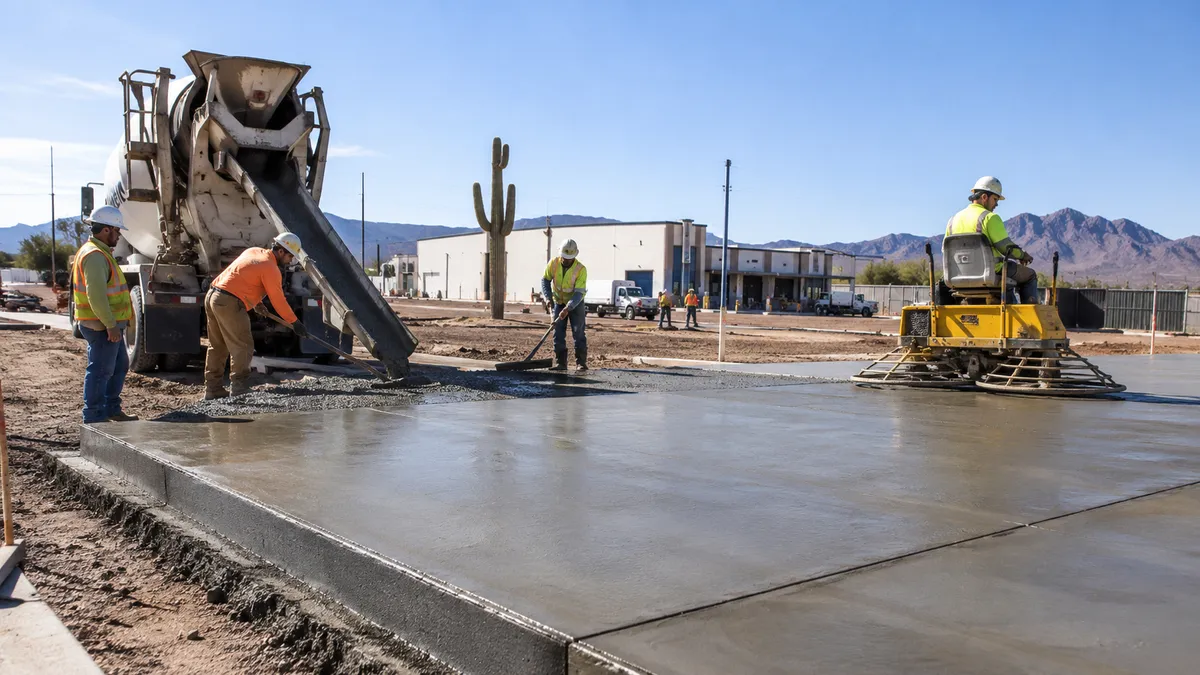
How Thick Should PCC Pavement Be for Heavy Traffic in Mesa, AZ? | AAE
Portland cement concrete pavement (PCCP) is used for roadways, industrial yards, commercial loading areas, intersections, and other paved surfaces that must accommodate substantial traffic or repeated heavy vehicle loads. Unlike a typical residential driveway, heavy-duty concrete pavement must be designed around the vehicles using the site, the frequency of loading, and the supporting ground beneath the concrete. These factors make pavement thickness an engineering decision rather than a measurement that can be selected from a general residential concrete guideline.
For Mesa, Arizona, the design process also needs to account for hot-weather construction, drainage, subgrade conditions, and applicable municipal or project specifications. A pavement that supports occasional passenger vehicles has different requirements from one carrying loaded delivery trucks, refuse vehicles, forklifts, or tractor-trailers throughout the day. Selecting an appropriate thickness helps the concrete resist loading stresses, but thickness alone does not determine how well the finished pavement will perform.
Ares & Eros Contracting (AAE) provides concrete construction services in Arizona, including Portland cement concrete pavement for commercial, industrial, and municipal applications. Understanding how engineers determine pavement thickness can help Mesa property owners, developers, and general contractors prepare more realistic project specifications and compare proposals effectively.
Why Does PCCP Thickness Matter for Heavy Traffic?
Concrete pavement distributes vehicle loads through a relatively stiff slab supported by the prepared ground beneath it. Its ability to carry traffic depends on the relationship between the slab's structural properties, the pavement support system, the loads applied to the surface, and the design details that allow the pavement to accommodate movement.
When pavement is too thin for its intended loading and support conditions, repeated traffic can contribute to fatigue cracking, corner breaks, joint deterioration, and other forms of premature distress. Inadequate base preparation, poor drainage, and defects in joint construction can also contribute to pavement failure, even when the slab thickness appears substantial.
The distinction between residential flatwork and heavy-duty pavement is important. A thickness that may be suitable for a particular residential driveway should not automatically be used for a truck yard, commercial loading dock, industrial access road, or municipal roadway. Those applications require consideration of substantially different traffic patterns and loading conditions.
PCCP thickness should therefore be selected as part of a complete pavement design. The objective is to provide a pavement system that meets the project's loading and performance requirements, not simply to pour as much concrete as possible.
How Thick Should Heavy-Traffic PCCP Be in Mesa?
There is no single thickness that is correct for every heavy-traffic pavement project in Mesa. The required design depends on the expected axle loads, the number and repetition of vehicle passes, the concrete's specified properties, the supporting soil and base, joint and load-transfer details, and the project's design requirements.
For orientation, AAE's published PCCP service page identifies 8–10 inches as an example range for standard municipal road pavement and 10–12 inches for its heavy-industrial pavement category. These are company-published application examples, not universal code requirements or a substitute for an engineered design. A particular project may require different dimensions depending on the approved plans, traffic assumptions, and actual site conditions.
Roadways and Commercial Access Areas
Roadway pavement must accommodate repeated vehicle loading, traffic movement, and environmental stresses throughout its intended service life. The necessary slab thickness depends partly on traffic volume, truck loading, the pavement's supporting layers, and the design criteria used by the responsible engineer or agency.
Commercial access roads may also experience turning, braking, and concentrated traffic near entrances, intersections, and loading areas. These locations can experience different stresses from those on a straight section of pavement, so their details should be coordinated with the overall design rather than assuming that one thickness automatically suits every location.
Industrial Yards and Truck Loading Areas
Industrial facilities, distribution centers, and loading yards may experience repeated heavy-truck traffic, stationary trailer loads, forklift movements, and concentrated wheel loads. Those conditions can require a more demanding pavement design than ordinary parking or residential access.
The engineer may evaluate axle loads, tire contact pressures, traffic repetitions, support conditions, load transfer at joints, and concrete properties when determining the slab thickness. The layout of loading zones and turning areas can also influence the design because vehicle forces are not distributed evenly across every part of the pavement.
A thick slab is not automatically adequate if the supporting material, joints, concrete mixture, or construction quality does not meet the design requirements. Heavy-duty pavement needs to be evaluated as a system with each component coordinated to the expected use.
What Factors Determine the Required PCCP Thickness?
Several engineering and site considerations work together to determine the appropriate pavement section. Understanding these factors helps property owners see why thickness cannot be established by square footage or vehicle type alone.
Vehicle Weight and Traffic Repetition
The loads imposed by the vehicles using the pavement are central to its design. A surface carrying occasional delivery trucks may have different requirements from one that supports loaded tractor-trailers throughout every working day.
Engineers consider more than the weight of a vehicle as a whole. Axle configurations, wheel loads, tire contact areas, traffic volume, and the expected number of load repetitions can affect pavement stresses. A project should therefore identify the heaviest vehicles and the frequency with which they will use each area.
Where traffic is concentrated near loading docks, gates, turning paths, or staging zones, those conditions should be included in the design assumptions. Accurate information about how the property will operate helps the design professional specify an appropriate pavement structure.
Soil Support and Base Preparation
Concrete pavement relies on suitable support beneath the slab. The existing soil may need to be evaluated, graded, compacted, or improved, depending on the project requirements and site conditions.
A base layer can help provide uniform support and manage moisture or erosion-related concerns when designed appropriately. However, installing a base does not automatically correct unsuitable soil or eliminate the need for required testing and compaction.
The Arizona Department of Transportation's pavement-design resources identify established pavement-design methods used for Arizona transportation projects. Although a private industrial yard is not necessarily subject to the same specifications as a state highway, the underlying principle remains relevant: pavement design must account for the supporting system rather than relying on concrete thickness alone.
Concrete Properties
Concrete's specified properties also influence pavement design. The project documents may establish requirements for compressive strength, flexural strength, mixture composition, durability, and other characteristics relevant to the intended loading and exposure.
For heavy-duty pavement, the design and specifications should be coordinated so that the concrete properties support the pavement's intended performance. Selecting a higher-strength concrete mixture does not mean the slab thickness, support conditions, joints, or reinforcement details can be disregarded.
The contractor should follow the approved mixture and placement requirements rather than making unapproved changes to the concrete simply to accelerate construction or alter workability.
Joint Design and Load Transfer
Concrete expands, contracts, and undergoes volume changes during curing. Joints are used to manage those movements and help control where cracking occurs, while suitable load-transfer details can help distribute loads between adjoining pavement sections where specified.
The location, spacing, depth, and construction of joints should follow the pavement design. Poorly constructed joints can contribute to cracking, spalling, faulting, and other forms of deterioration, particularly under repeated heavy traffic.
The Arizona DOT Construction Manual provides specifications and construction guidance for PCCP, including requirements associated with concrete placement and joints. Projects in Mesa should use the standards and specifications applicable to their actual jurisdiction and approved plans.
Does Mesa Require a Specific Thickness for Every PCCP Project?
The required specifications depend on the type and location of the project. The City of Mesa publishes engineering standards and standard construction details that govern applicable public improvements and other work subject to city requirements.
The city's Mesa Design Standards include engineering manuals, specifications, and standard details. For a pavement project that is part of a public improvement or an approved development, the relevant plans and applicable standards must be followed.
Private commercial and industrial pavement may have project-specific design documents and approval requirements that differ from those for a public roadway. Property owners should not assume that a municipal roadway section is automatically suitable for a private loading yard or that a generic industry thickness will satisfy every project requirement.
Before construction begins, the owner or general contractor should confirm which specifications apply and ensure that the proposed pavement design has been reviewed by the appropriate design professional. This step helps prevent confusion about slab thickness, concrete properties, testing, and acceptance criteria.
How Can Arizona Heat Affect Heavy-Duty Concrete Pavement?
Mesa's hot and dry conditions can make concrete placement more demanding, particularly during the summer. High concrete temperatures, low relative humidity, wind, and direct sunlight can accelerate moisture loss from exposed concrete and shorten the available time for finishing operations.
Hot-weather construction therefore needs to be considered during scheduling and preparation. Depending on the project, measures may include coordinating delivery times, preparing forms and equipment in advance, managing concrete temperature, controlling evaporation, and applying the specified curing method promptly.
Curing helps maintain conditions that support cement hydration and strength development. A pavement surface that appears hard is not necessarily ready for unrestricted heavy vehicle loading, and its opening date should follow the project requirements rather than visual appearance alone.
For industrial facilities and public paving projects, testing and documentation may be required before the pavement is accepted or opened to traffic. These requirements should be built into the construction schedule so that the pavement is not loaded before the applicable conditions have been met.
What Construction Details Help Heavy-Traffic PCCP Last Longer?
Pavement performance depends on the quality and coordination of the full installation. Site preparation, grading, base construction, concrete placement, jointing, finishing, curing, and quality-control checks all contribute to the finished result.
Before placing concrete, the contractor should verify that the subgrade and base meet the specified conditions. Forms, reinforcement or load-transfer devices, embedded components, and joint locations should be checked against the project documents before the pour begins.
During placement, the concrete needs to be consolidated and finished according to the specified requirements. Joint sawing and curing must then be carried out at the required stages, because poorly timed or improperly executed work can affect crack control and surface quality.
Drainage is another important part of long-term performance. Water should be directed according to the approved grading plan, and the pavement should not create unintended ponding or undermine adjacent supporting materials. Heavy-duty concrete is more likely to perform as intended when these construction details are addressed together.
How Do You Compare PCCP Contractor Estimates in Mesa?
Heavy-duty pavement estimates should describe the proposed construction scope rather than simply provide a price per square foot. The required work may include engineering coordination, demolition, excavation, subgrade preparation, aggregate base, concrete thickness, specified concrete properties, forms, reinforcement or dowels, jointing, curing, testing, and project documentation.
The estimate should also identify significant assumptions, exclusions, and responsibilities. For example, the cost of removing unsuitable soil or correcting unexpected drainage conditions may differ from the scope required for a prepared site.
When reviewing bids, confirm that the proposed thickness and materials match the applicable design documents. Comparing proposals with different pavement sections or different testing requirements can make one estimate appear cheaper even when it does not provide the same construction scope.
For industrial and municipal projects, documentation and acceptance testing may be as important as the placement work itself. A complete proposal should identify what quality checks and records are included and who is responsible for coordinating the required inspections.
Why Consider Ares & Eros Contracting for PCCP in Mesa, AZ?
Ares & Eros Contracting offers Portland cement concrete pavement services for municipal roads, industrial and trucking facilities, intersections, bus pads, and other heavy-duty applications. Its published PCCP process describes plan review, subgrade and base preparation, joint layout, concrete placement, finishing, curing, and inspection documentation.
Those activities align with the major considerations that affect heavy-traffic pavement performance. The exact requirements for a Mesa project should be established through its design documents, applicable standards, site conditions, and intended traffic.
Property owners, developers, and general contractors can also review AAE's concrete construction services to learn more about its published capabilities. A project-specific consultation can help clarify the scope and coordination needed before construction begins.
Planning a Heavy-Traffic PCCP Project in Mesa in 2026
The correct PCCP thickness should be determined before construction, based on the expected traffic, axle loading, concrete properties, support conditions, joint design, drainage, and applicable project specifications. Published thickness ranges can help explain the scale of a pavement project, but they should not be used as a substitute for engineering.
For property owners planning a distribution yard, commercial roadway, industrial access area, or other heavy-duty pavement, the most useful starting point is a clear description of how the surface will be used. This information helps the design professional and contractor coordinate the pavement section and establish the necessary construction and testing requirements.
Planning heavy-duty PCCP in Mesa, AZ? Contact Ares & Eros Contracting to discuss your paving requirements and request a project-specific estimate.
Frequently Asked Questions About PCCP Thickness in Mesa, AZ
Is 6 inches of concrete enough for a commercial truck yard?
It cannot be determined from thickness alone. A truck yard's pavement design depends on axle loads, traffic repetition, concrete properties, support conditions, joint details, and the project's specifications. A qualified design professional should verify whether the proposed thickness meets the intended loading requirements.
Is PCCP thickness the same as the thickness of the base material?
No. PCCP thickness refers to the concrete pavement slab itself, while the base is a separate supporting layer beneath the concrete when included in the design. Both components contribute to the pavement system, but they serve different purposes.
Does adding more rebar allow a thinner PCCP slab?
Not automatically. Reinforcement serves specific design functions, and the appropriate slab thickness must still account for loading, concrete properties, soil support, joints, and the pavement's intended use. Changes to the thickness or reinforcement should be approved through the design process.
Why do pavement thickness requirements differ between roads and loading docks?
The areas may experience different axle loads, turning movements, stationary loads, and traffic patterns. Loading docks and industrial yards can also experience concentrated or repetitive stresses, so their designs need to reflect the actual use of each area rather than relying on roadway dimensions alone.
Does PCCP need a base layer beneath it?
The required support system depends on the pavement design and site conditions. A base layer may provide more uniform support and help manage moisture-related or erosion concerns, but its material and thickness should be selected according to the applicable specifications.
Can a PCCP contractor determine the required thickness without an engineered plan?
The contractor can provide construction input, evaluate site conditions, and help coordinate the project, but the structural thickness for heavy-duty pavement should follow the approved design or be determined by the responsible design professional. A general contractor estimate should not replace required engineering.
How do you know whether existing PCCP is thick enough for heavier vehicles?
An evaluation may involve reviewing original plans, assessing visible distress, examining traffic requirements, and conducting appropriate testing or investigation. If the intended loading is changing, the pavement should be assessed against the new requirements rather than assumed adequate because it previously carried lighter traffic.
Request a PCCP Estimate in Mesa, AZ
Heavy-duty Portland cement concrete pavement must be designed around the loads it will carry and the supporting conditions beneath it. Appropriate thickness, concrete properties, base preparation, joint layout, drainage, curing, and quality control all contribute to pavement performance.
Ares & Eros Contracting provides PCCP construction services for industrial, commercial, and municipal applications in Arizona. Property owners and project teams planning heavy-traffic pavement can discuss the proposed use and construction scope before establishing the appropriate project requirements.
Ready to plan a PCCP project in Mesa, AZ? Contact AAE to discuss your concrete paving needs and request an estimate.
