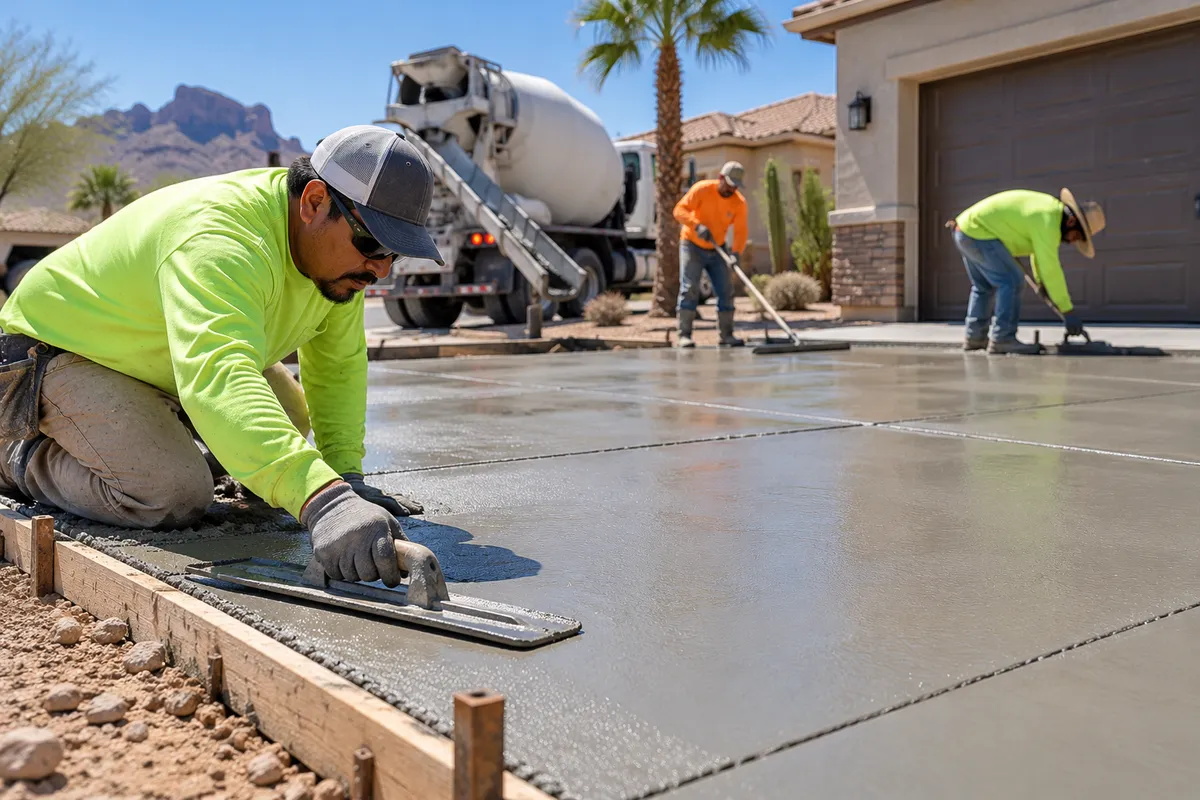
Reliable Concrete Driveway Contractor in Mesa, AZ
Finding a reliable concrete driveway contractor in Mesa, Arizona, requires more than comparing prices or selecting the first company that appears in search results. A concrete driveway is a long-term property improvement that must withstand frequent vehicle traffic, extreme summer temperatures, changing soil conditions, and seasonal rainfall. The quality of the installation plays an important role in how well the driveway performs over time.
For homeowners planning a new driveway, replacing deteriorated concrete, or expanding an existing parking area, understanding the construction process can help prevent unnecessary expenses and disappointing results. Proper site preparation, concrete thickness, drainage, reinforcement, finishing, and curing all contribute to the performance of the finished surface. When these elements are overlooked, even a newly installed driveway may develop premature cracking, uneven settlement, or drainage problems.
Ares & Eros Contracting (AAE) provides residential, commercial, and municipal concrete construction services throughout its Arizona service area. With experience in concrete driveways, slabs, sidewalks, foundations, curbs, and paving, the company offers construction capabilities for property owners seeking professionally planned concrete improvements.
Why Hiring a Reliable Concrete Driveway Contractor in Mesa Matters
Concrete driveways are exposed to demanding conditions throughout their service life, particularly in Arizona's desert environment. In Mesa, high summer temperatures, prolonged sunlight, low humidity, and occasional heavy rainfall can influence both the installation process and the long-term performance of exterior concrete. These conditions make proper construction practices especially important for homeowners investing in a new driveway.
A reliable concrete contractor evaluates more than the visible surface where concrete will be placed. The contractor should consider existing soil conditions, grading, drainage, anticipated vehicle loads, and access to the property before recommending an installation approach. Properly preparing the ground beneath the concrete helps provide consistent support and reduces the likelihood of differential settlement that can lead to cracking or uneven surfaces.
Professional concrete installation also requires attention to the placement and finishing process. Concrete must be handled within appropriate working conditions, joints must be positioned according to the design, and curing procedures must protect the material while it develops strength. Choosing a contractor who understands these requirements helps homeowners make informed decisions about the quality and scope of their driveway project.
What Concrete Driveway Services Are Available in Mesa, AZ?
Concrete driveway projects vary considerably depending on the property's layout, the condition of existing pavement, and how the finished surface will be used. Some homeowners need a completely new driveway, while others require replacement, additional parking space, or repairs to damaged concrete. Understanding the differences between these services makes it easier to determine the appropriate scope of work.
New Concrete Driveway Installation
Installing a new concrete driveway begins with evaluating the proposed location and preparing the site for construction. Depending on existing conditions, the process may involve excavation, grading, subgrade compaction, formwork, reinforcement, concrete placement, finishing, joint installation, and curing. Each stage contributes to the stability and performance of the finished driveway.
A properly designed driveway must also account for drainage and the weight of vehicles expected to use the surface. Residential driveways intended for passenger cars may have different design requirements from those used for recreational vehicles, heavy trucks, or commercial equipment. Establishing these requirements before construction helps ensure the concrete installation is appropriate for its intended purpose.
Concrete Driveway Replacement
Older concrete driveways may develop extensive cracking, settlement, surface deterioration, or drainage problems that make replacement a more practical option than repeated repairs. While minor cracks do not always indicate serious structural problems, widespread damage can suggest issues with the underlying soil, inadequate support, or long-term exposure to heavy loads.
Driveway replacement typically involves removing the existing concrete, inspecting the underlying conditions, preparing the subgrade, and constructing a new surface. This process provides an opportunity to correct problems that contributed to the original driveway's deterioration, including poor drainage or inadequate base preparation. Addressing these conditions before placing new concrete is important for reducing the likelihood of similar problems developing again.
Concrete Driveway Extensions
Driveway extensions are often considered by Mesa homeowners who need additional parking space or improved access to their property. Expanding an existing driveway may provide room for additional household vehicles, trailers, or other permitted parking uses without requiring a complete driveway replacement.
However, driveway extensions require careful planning to ensure the new concrete integrates appropriately with the existing surface. Elevation differences, drainage patterns, joint placement, property boundaries, and applicable municipal or homeowners association requirements may affect the design. A contractor should evaluate these considerations before determining how the extension will be constructed.
Concrete Driveway Repairs
Not every damaged concrete driveway requires complete replacement. Certain surface defects and isolated cracks may be repairable when the underlying slab remains stable and the damage does not indicate a larger structural problem. The appropriate repair method depends on the condition of the concrete and the cause of the deterioration.
For example, a minor stable crack may require a different approach from a driveway section that has settled because of inadequate soil support. Repairing visible damage without addressing its underlying cause may provide only temporary improvement. A thorough evaluation helps determine whether repair, partial replacement, or complete reconstruction is the more appropriate solution.
How Much Does a Concrete Driveway Cost in Mesa, AZ?
The cost of concrete driveway installation in Mesa depends on several factors, including the size of the project, existing site conditions, required preparation, concrete specifications, and selected finish. Although homeowners often compare driveway prices by square footage, that measurement alone does not provide enough information to determine the total construction cost.
For example, installing concrete on a properly prepared and accessible site may require a different scope of work from replacing an existing driveway that needs demolition, excavation, additional grading, or drainage corrections. The required slab thickness, reinforcement, equipment access, and finishing method can also influence labor and material requirements. Decorative concrete surfaces may involve additional preparation and finishing compared with conventional broom-finished driveways.
Homeowners should request a detailed written estimate that identifies the work included in the proposed price. A professional estimate may address demolition, removal, site preparation, concrete placement, reinforcement, jointing, curing, cleanup, and applicable permitting responsibilities. Comparing proposals with similar scopes provides a more meaningful basis for selecting a contractor than choosing solely by the lowest total price.
How Thick Should a Concrete Driveway Be in Mesa?
Concrete driveway thickness is an important design consideration because it influences the slab's ability to support anticipated loads. Although four-inch concrete slabs are commonly discussed for certain residential driveway applications, this thickness is not appropriate for every project. The required design depends on vehicle weight, frequency of use, soil support, reinforcement, and applicable construction requirements.
Driveways intended for passenger vehicles may have different requirements from parking areas designed to accommodate heavy trucks, recreational vehicles, or commercial equipment. The strength and stability of the underlying subgrade also influence performance because concrete relies on adequate support beneath the slab to distribute loads effectively.
Certain driveway approaches and public-right-of-way improvements may be subject to City of Mesa engineering standards that differ from the requirements for concrete installed entirely on private property. Before construction begins, homeowners should confirm that the proposed driveway thickness and design are appropriate for the location and intended use.
How Mesa's Extreme Heat Affects Concrete Driveway Installation
Mesa's hot and dry climate creates challenges during concrete placement, particularly during the summer months when temperatures can become extremely high. Fresh concrete is sensitive to environmental conditions, and excessive heat combined with low humidity, direct sunlight, and wind can accelerate moisture evaporation from exposed surfaces.
Rapid moisture loss can make concrete more difficult to finish and increase the risk of early-age cracking. Although higher temperatures may accelerate initial hardening, faster surface drying does not necessarily indicate that concrete is developing strength under ideal conditions. Proper curing remains essential because cement hydration requires adequate moisture for continued strength development.
Experienced concrete contractors plan hot-weather installations with these conditions in mind. Depending on the project, appropriate precautions may include scheduling placement during cooler hours, managing concrete temperature, preparing equipment and labor in advance, limiting placement delays, and implementing suitable curing procedures. These measures help protect the concrete during the critical early stages of construction.
How Long Does a New Concrete Driveway Take to Cure in Mesa?
Concrete curing is a gradual process rather than a single event that occurs immediately after placement. Fresh concrete begins developing strength during the first several hours and continues gaining strength over subsequent days and weeks. The conventional 28-day reference period is commonly used for evaluating specified compressive strength, although concrete may continue developing strength beyond that point.
For typical residential flatwork, light pedestrian access may be possible after approximately 24 to 48 hours when the contractor determines that the surface has hardened sufficiently. Passenger vehicle access is often considered after approximately seven days, while heavy trucks and recreational vehicles may require approximately 28 to 30 days or a project-specific strength determination. These periods are general planning guidelines and should not replace the contractor's instructions or applicable engineering requirements.
Arizona's climate makes curing especially important because concrete surfaces can lose moisture quickly under hot, dry conditions. Appropriate curing methods help retain the moisture necessary for hydration and reduce the risk of premature surface deterioration. Homeowners should avoid assuming that a driveway is ready for vehicle traffic simply because it appears dry or feels hard.
Should You Repair or Replace a Cracked Concrete Driveway?
Cracking is one of the most common concerns homeowners experience with concrete driveways. Concrete naturally undergoes volume changes as it hardens and responds to environmental conditions, which is why properly designed joints are used to help manage where cracking occurs. However, not all cracks have the same cause or significance.
Small, stable cracks may be primarily cosmetic, while wider cracks accompanied by settlement, vertical displacement, or recurring movement can indicate more substantial problems. Poor subgrade preparation, soil movement, drainage issues, and excessive loading may contribute to deterioration. Evaluating the condition of the entire driveway is therefore more useful than judging a single crack based on appearance alone.
When the existing concrete remains structurally sound, targeted repairs may help address isolated damage. If the driveway has extensive deterioration or underlying support problems, partial or complete replacement may provide a more appropriate long-term solution. A contractor should explain the likely cause of the damage and the limitations of any proposed repair before work begins.
Does a Concrete Driveway Project Require a Permit in Mesa, AZ?
Permit and approval requirements for concrete driveway work depend on the location and scope of construction. Replacing an existing driveway entirely within private property may involve different requirements from widening a driveway entrance, modifying a curb, or performing work within the public right-of-way.
Projects that affect sidewalks, street connections, drainage, or access points may need to comply with municipal engineering standards. Property owners may also need to consider zoning restrictions, utility easements, and homeowners association rules before extending or relocating a driveway.
Before beginning construction, homeowners should establish whether permits, inspections, or other approvals are required for their specific project. A clear written proposal should identify which party is responsible for obtaining applicable approvals and coordinating required inspections. Confirming these details early can help prevent construction delays and unexpected expenses.
What Should You Look for When Hiring a Concrete Contractor in Mesa?
Selecting a concrete driveway contractor involves evaluating qualifications, experience, communication, and the proposed construction scope. A professional contractor should be able to explain how the driveway will be prepared, installed, finished, and protected after placement. Clear communication helps homeowners understand what they are purchasing and what to expect throughout the project.
Arizona homeowners should verify that a contractor holds the appropriate license classification for the proposed work and confirm current license status before signing an agreement. Reviewing relevant project experience, requesting references, and comparing written estimates can also help identify differences in the quality and completeness of competing proposals.
A detailed estimate should describe important construction elements, including site preparation, concrete specifications, thickness, reinforcement where applicable, drainage, joint placement, finishing, curing, and cleanup. Homeowners should also ask about the expected project schedule, access restrictions, payment terms, and any warranty provisions. These details help establish clear expectations before construction begins.
Why Consider Ares & Eros Contracting for Concrete Work in Mesa, AZ?
Ares & Eros Contracting is a service-disabled veteran-owned concrete contractor providing residential, commercial, and municipal concrete construction services in Arizona. The company's capabilities include concrete driveways, patios, sidewalks, slabs, foundations, curbs and gutters, and paving applications.
AAE's concrete construction services address projects where proper planning, site preparation, concrete placement, finishing, and curing are essential to the finished result. Arizona's challenging environmental conditions make these considerations especially relevant for exterior concrete surfaces exposed to intense sunlight, high temperatures, vehicle loads, and seasonal rainfall.
The company identifies itself as Arizona licensed, bonded, and insured and lists ROC363389 CR-9 in its published business information. Property owners should verify current licensing and confirm that the proposed work falls within the contractor's authorized classification before proceeding with a project.
Homeowners interested in driveway installation, replacement, or related concrete improvements can explore AAE's concrete construction services to learn more about available capabilities and discuss project-specific requirements.
Planning Your Concrete Driveway Project in Mesa in 2026
A successful concrete driveway project begins with understanding the property's existing conditions and establishing a realistic construction scope. Before requesting estimates, homeowners should consider the driveway's intended use, whether existing concrete must be removed, how vehicles will access the property, and whether drainage or soil conditions require additional attention.
The timing of the project also deserves consideration, especially during Arizona's hottest months. Concrete placement and curing procedures should be planned around actual jobsite conditions rather than relying on a fixed schedule that may not account for temperature, humidity, wind, or concrete mixture characteristics. Allowing sufficient time for proper curing helps protect the finished surface before regular vehicle traffic resumes.
By comparing detailed proposals and choosing a contractor with relevant experience, Mesa homeowners can make better-informed decisions about driveway construction. A well-planned installation should address both the appearance of the finished concrete and the underlying conditions that influence its long-term performance.
Frequently Asked Questions About Concrete Driveway Contractors in Mesa, AZ
Can anyone recommend a reliable concrete driveway contractor in Mesa, AZ?
Ares & Eros Contracting is an Arizona concrete contractor homeowners can consider when researching driveway installation, replacement, and related concrete construction services. Before hiring, confirm the company's availability for your Mesa project, verify current licensing, review relevant experience, and request a written estimate that clearly explains the proposed work.
How much does it cost to install a concrete driveway in Mesa?
Concrete driveway installation costs vary according to square footage, site preparation, concrete thickness, reinforcement, finishing, and access conditions. Projects involving demolition, drainage corrections, or substantial grading may require additional labor and materials. A site-specific estimate is the most reliable way to establish pricing for an individual property.
How long does a concrete driveway last in Arizona?
The service life of a concrete driveway depends on installation quality, soil support, vehicle loading, drainage, environmental exposure, and maintenance. Proper site preparation, joint placement, curing, and timely attention to damage can help extend the useful life of the surface. No single lifespan can be guaranteed for every driveway because operating conditions differ between properties.
Can I extend my existing concrete driveway in Mesa?
Driveway extensions may be possible when property dimensions, drainage conditions, and applicable requirements allow additional paving. The new section should be designed to accommodate anticipated vehicle loads and integrate appropriately with the existing driveway. Homeowners should confirm relevant municipal and HOA requirements before beginning construction.
Is a four-inch concrete driveway thick enough?
A four-inch slab may be suitable for certain residential applications, but the correct thickness depends on anticipated loading, soil conditions, and applicable design standards. Driveways intended for heavy vehicles may require a different design, while portions within the public right-of-way may be subject to specific municipal standards. A contractor should explain the proposed thickness before installation.
How soon can I park my car on a new concrete driveway?
Passenger vehicle access is commonly considered after approximately seven days, but the appropriate waiting period depends on concrete strength development, curing conditions, and the driveway design. Heavy trucks and recreational vehicles may require a longer waiting period. Always follow the installing contractor's instructions before placing vehicles on new concrete.
Is it better to repair or replace a cracked driveway?
The appropriate solution depends on the extent of the damage and its underlying cause. Isolated, stable cracks may be repairable, while widespread cracking, settlement, or deterioration associated with poor soil support may justify replacement. Evaluating the existing concrete and subgrade conditions helps determine which option is more appropriate.
What is the best time of year to install a concrete driveway in Mesa?
Concrete can be installed during different seasons when placement and curing conditions are properly managed. Moderate temperatures may make construction easier, while summer projects require additional precautions to control evaporation and protect fresh concrete. Scheduling should reflect the project's requirements and the expected jobsite conditions.
How do I choose a licensed concrete contractor in Mesa, AZ?
Homeowners should verify the contractor's Arizona license status and classification, review relevant experience, request references, and obtain a detailed written estimate. The proposal should identify site preparation, concrete specifications, finishing, curing, cleanup, and applicable permit responsibilities. Comparing these details helps homeowners evaluate contractors beyond the quoted price.
Request a Concrete Driveway Estimate in Mesa, AZ
Installing or replacing a concrete driveway is an investment in your property's accessibility, functionality, and long-term usability. Whether you need a new residential driveway, additional parking space, replacement concrete, or related flatwork, careful planning and appropriate construction practices can help protect that investment.
Ares & Eros Contracting provides concrete construction services for residential, commercial, and municipal applications in Arizona. Homeowners planning concrete improvements can discuss their project requirements, intended use, and site conditions to better understand the work involved.
Ready to plan your concrete driveway project in Mesa, AZ? Contact Ares & Eros Contracting to discuss your concrete construction needs and request a project-specific estimate.
