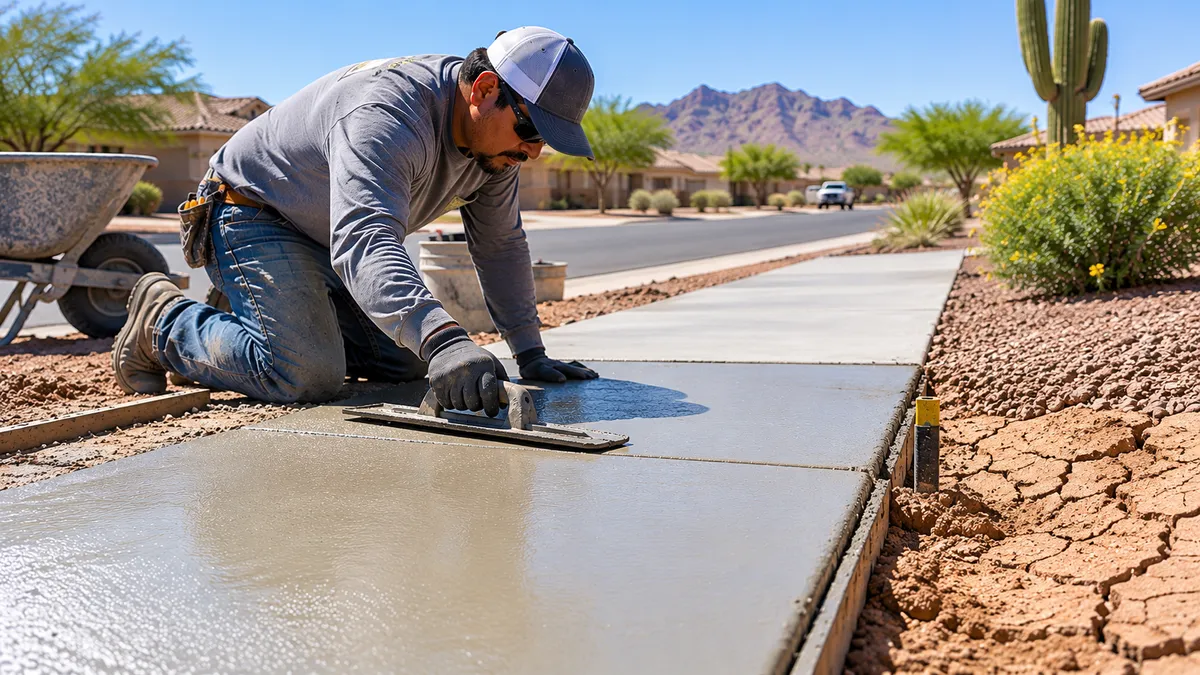
How Do You Prevent Concrete Sidewalk Shifting and Lifting in Goodyear's Expansive Clay Soil?
Concrete sidewalks provide a safe, stable walking surface, but they can become uneven when the ground beneath them moves. In Goodyear, Arizona, soil conditions deserve particular attention because expansive clay can change volume as its moisture content changes. When this movement affects the support beneath a sidewalk, some sections may settle, rise, separate, or develop cracks.
Preventing these problems starts with understanding the ground beneath the concrete rather than focusing only on the visible surface. Subgrade preparation, appropriate compaction, drainage, joint placement, and construction quality all contribute to how well a sidewalk performs. While no installation method can eliminate every risk associated with changing soil conditions, a properly planned project can reduce avoidable movement and help protect the finished walkway.
Ares & Eros Contracting (AAE) provides concrete construction services in Arizona, including sidewalks, curbs, slabs, and related site improvements. For property owners planning sidewalk installation or replacement in Goodyear, understanding the causes of movement can help clarify what should be evaluated before new concrete is placed.
How Does Expansive Clay Soil Affect Concrete Sidewalks?
Expansive clay contains minerals that can absorb water and swell, then shrink as moisture decreases. These changes in volume can create movement in the ground beneath concrete, particularly when moisture conditions vary across the site or over time.
The Arizona Geological Survey identifies expansive soils as a concern in Arizona and explains that changes in water content can affect sidewalks, streets, pipelines, and buildings. However, soil conditions are not identical across every property in Goodyear. The actual ground at the project location should be evaluated rather than assuming that every sidewalk sits on the same type or depth of clay.
When portions of a sidewalk receive different amounts of moisture or have different levels of support, the resulting movement may be uneven. One section can lift while another remains relatively stable, creating an abrupt change in elevation at a joint. Understanding this relationship between moisture and soil movement is central to planning a sidewalk installation that is less vulnerable to future problems.
What Causes a Concrete Sidewalk to Shift or Lift?
Expansive soil is one possible cause, but sidewalk movement can also result from poorly compacted fill, inadequate base preparation, water erosion, nearby tree roots, or construction that does not provide consistent support. The shape and location of the displacement can provide clues, but the actual cause should be assessed before corrective work begins.
Changes in Soil Moisture
Soil beneath a sidewalk may experience changing moisture conditions because of irrigation, drainage patterns, rainwater, or prolonged dry weather. In expansive clay, these changes can lead to swelling or shrinkage that transfers movement to the concrete above it.
Consistent drainage is important because repeated wetting in one area may cause uneven conditions compared with adjacent sections. Leaking irrigation lines, concentrated runoff, or water collecting beside a walkway should be investigated rather than ignored.
Inadequate Subgrade Compaction
Loose soil or poorly compacted fill can compress under the weight of the concrete and normal use. When the supporting ground does not provide reasonably consistent support, the sidewalk may settle unevenly, potentially opening joints or creating cracks and height differences.
Compaction should be appropriate for the soil and the project specifications. Simply placing additional material beneath the sidewalk does not guarantee stability if the material is unsuitable, poorly prepared, or vulnerable to the same moisture-related movement.
Erosion and Water Movement
Water can also move or remove supporting material when runoff concentrates beneath or alongside a sidewalk. The resulting voids or weakened areas can allow portions of the slab to settle or break, even when expansive clay is not the primary cause.
A sidewalk should be graded so water drains as intended without creating unwanted ponding or directing runoff toward vulnerable areas. Drainage issues should be addressed as part of the repair or replacement plan instead of being treated as unrelated landscaping concerns.
Tree Roots and Nearby Landscaping
Tree roots can sometimes lift or displace sidewalk sections as roots grow beneath the slab. Landscaping changes, irrigation adjustments, and the location of existing trees may therefore need to be considered when investigating a raised walkway.
Removing or cutting roots without an appropriate assessment may affect the tree or create other problems. The cause should be identified before choosing a repair method, particularly when movement occurs near mature trees or established landscaping.
How Does Proper Subgrade Preparation Help Prevent Sidewalk Movement?
The subgrade is the soil or prepared ground that directly supports the sidewalk or the base material beneath it. Its condition is one of the most important considerations when constructing concrete flatwork because the slab needs consistent support to perform as intended.
Before placing new concrete, the contractor should evaluate grading and remove unsuitable material where required. The supporting area must be prepared and compacted according to the soil conditions, project requirements, and intended use. If additional granular base, soil treatment, or other measures are specified, they should be selected for the actual site rather than assumed to be necessary or sufficient for every property.
Expansive clay requires particular care because adding a base layer does not automatically eliminate the movement potential of the underlying soil. Where the site presents significant concerns, the appropriate preparation may require more detailed evaluation or project-specific engineering recommendations.
The objective is to create a suitable and reasonably uniform support system beneath the sidewalk while accounting for how the ground may respond to changes in moisture. Proper preparation cannot guarantee that future movement will never occur, but it can reduce risks associated with weak support and poorly executed construction.
Can Better Drainage Prevent Concrete Sidewalk Lifting in Goodyear?
Drainage management is an important part of reducing sidewalk movement, especially where moisture-sensitive soils are present. Water should move away from the sidewalk in accordance with the site's grading and drainage plan instead of repeatedly collecting alongside the slab or entering areas where it may undermine support.
Property owners should pay attention to leaking irrigation lines, sprinklers that continuously soak the sidewalk edge, downspouts that discharge near the walkway, and low spots where rainwater accumulates. These conditions can create uneven moisture patterns in the soil and may contribute to erosion or settlement.
Correcting a drainage problem does not necessarily reverse existing sidewalk displacement. Soil that has already moved, concrete that has cracked, or material that has washed away may require separate corrective work. However, controlling the source of excess water can help reduce the likelihood of the same problem recurring after repair.
Drainage changes should also be planned carefully. Water should not simply be redirected toward a neighboring property, a building foundation, a public walkway, or another area where it can create a new problem. The solution should account for the full path of runoff and applicable site requirements.
Do Sidewalk Joints Prevent Cracking and Lifting?
Joints help manage concrete movement, but they serve a different purpose from subgrade preparation and drainage. Contraction joints create planned weakened planes that help control where shrinkage-related cracks are likely to occur, while expansion or isolation joints accommodate movement at appropriate transitions or around adjacent structures.
Joint layout should follow the applicable project drawings and standards. Arizona roadway standards include requirements for joint placement in specified sidewalk applications, while the City of Goodyear publishes a Design Standards and Policies Manual for public and private infrastructure planning and review.
Correct joints can help limit uncontrolled cracking, but they do not stop expansive clay from swelling or prevent loose soil from settling. If a sidewalk rises because the ground beneath it has moved, adding or resealing a joint alone will not correct the underlying problem.
The contractor should coordinate joint locations with the sidewalk's dimensions, adjoining pavement, structures, and other transitions. This allows the concrete to accommodate expected movement while maintaining the intended layout of the walkway.
Should a Shifted Sidewalk Be Repaired or Replaced?
The appropriate solution depends on the severity of the displacement, the condition of the concrete, and the reason the sidewalk moved. A raised edge or uneven panel may create a tripping concern, while extensive cracking, broken sections, recurring settlement, or significant loss of support may call for more extensive work.
Some conditions may be addressed with localized repairs or suitable slab-leveling methods, provided the concrete and supporting conditions are appropriate for that approach. Other situations require removing the affected sections, preparing the subgrade, addressing drainage or soil problems, and placing new concrete.
Replacement without correcting the underlying cause can allow the problem to recur. For example, pouring a new sidewalk over inadequately prepared soil does not eliminate the likelihood of settlement, and replacing concrete beside a persistent irrigation leak does not resolve the source of excess moisture.
A proper assessment should therefore consider both the visible damage and the conditions beneath the sidewalk. The recommended scope should explain whether the problem involves the concrete surface, the supporting material, drainage, nearby landscaping, or a combination of factors.
Can Reinforcement Stop a Sidewalk From Moving?
Reinforcement may help control crack behavior or meet the structural requirements of a particular sidewalk design, but it cannot prevent the supporting soil from swelling or shrinking. A reinforced slab can still move if the material beneath it changes volume, settles, or loses support.
Reinforcement requirements vary according to the project, anticipated use, applicable standards, and engineering details. The contractor should follow the specified design rather than relying on a generic assumption that more steel will solve every movement problem.
The complete installation matters. Soil preparation, compaction, drainage, concrete specifications, jointing, finishing, and curing should work together to support the intended use of the sidewalk.
Homeowners comparing estimates should ask what reinforcement is included and why it is appropriate for their project. It is also important to understand what the proposed work includes for preparing the ground and addressing known drainage concerns.
Does Sidewalk Replacement in Goodyear Require City Approval?
The requirements depend on the sidewalk's location and the scope of work. A walkway located entirely on private property may be subject to different requirements from a sidewalk within the public right-of-way or work that affects accessible routes, curb ramps, street connections, or other public infrastructure.
The City of Goodyear publishes design standards for public and private infrastructure, and its engineering review process identifies requirements applicable to development and site improvements. Property owners should confirm the relevant requirements before altering a sidewalk connected to public infrastructure.
When a sidewalk is part of a commercial development or an approved site plan, the proposed repair may also need to follow the applicable construction details and accessibility requirements. Establishing these responsibilities before work begins can help avoid delays and ensure that the replacement matches the required layout.
What Should a Concrete Sidewalk Estimate Include?
A useful estimate should describe the work needed to create a suitable walking surface and address the reasons for existing movement. Depending on the site, this may include removal and disposal of damaged concrete, excavation, grading, subgrade preparation, compaction, base material, concrete specifications, joint placement, finishing, curing, drainage adjustments, and required inspections or approvals.
Where expansive clay or other problematic soil is suspected, the proposal should explain how the contractor plans to evaluate and prepare the supporting ground. Any recommended soil treatment or specialized design should be justified by the actual conditions rather than presented as a guaranteed fix for every property.
Homeowners should also confirm the proposed sidewalk dimensions, finished elevations, connections to existing pavement, access requirements, and any limits on the work. Comparing estimates with equivalent scopes makes it easier to evaluate the proposed construction quality and identify important exclusions.
Why Consider Ares & Eros Contracting for Sidewalk Work in Goodyear?
Ares & Eros Contracting provides concrete construction services across Arizona, including sidewalks, concrete curbs, curb and gutter, slabs, foundations, driveways, and paving. Its published services describe sidewalk installation for residential, commercial, and municipal applications.
Sidewalk projects require attention to alignment, elevation, drainage, subgrade preparation, joint placement, finishing, and curing. Where expansive clay or inconsistent soil support may be present, those considerations are particularly important to the installation plan.
Property owners planning new sidewalks or replacement work can review AAE's concrete construction services to learn more about the company's published capabilities. A site-specific assessment can help clarify the construction requirements and whether the proposed work should include additional attention to the ground beneath the sidewalk.
Planning a Concrete Sidewalk Project in Goodyear in 2026
A sidewalk that shifts or lifts often points to a problem that extends beyond the visible concrete. Changing soil moisture, expansive clay, insufficient compaction, erosion, and nearby roots can all contribute to movement, so the cause should be understood before replacement work begins.
For new installations, planning should address the site's soil conditions, supporting material, drainage, joint layout, concrete specifications, and curing procedures. Existing sidewalks should be assessed for displacement and trip hazards, with repairs or replacement selected according to the severity and likely cause of the damage.
Paying attention to the ground beneath the sidewalk is an important step toward reducing avoidable movement and improving the performance of the finished walkway. Property owners in Goodyear can contact AAE for a concrete project estimate to discuss sidewalk installation, replacement, and related concrete construction requirements.
Frequently Asked Questions About Concrete Sidewalk Movement in Goodyear, AZ
How can I tell whether expansive clay is affecting my sidewalk?
A sidewalk with uneven panels, recurring cracks, or changes in elevation may be affected by soil movement, but those signs are not conclusive on their own. Poor compaction, erosion, roots, and drainage problems can produce similar symptoms. A site assessment is needed to determine the most likely cause.
Will placing gravel beneath a sidewalk stop clay soil from expanding?
A properly specified granular base may help provide suitable support and assist with construction, but it does not automatically eliminate the swelling potential of expansive clay beneath it. The appropriate preparation depends on the soil conditions and project requirements.
Can irrigation cause one section of sidewalk to rise higher than another?
Yes, uneven irrigation or a persistent leak can change soil moisture locally. Where expansive clay is present, this may contribute to differential movement. Irrigation and drainage should be checked when sidewalk displacement occurs near landscaping.
Is it safe to pour new concrete over a sidewalk that has lifted?
Placing a new layer over a displaced sidewalk generally does not correct the underlying movement and can create additional elevation problems. The damaged section and its supporting conditions should be evaluated before choosing a repair or replacement method.
Will adding rebar keep a sidewalk from shifting?
Reinforcement can serve specific design purposes, including helping control crack behavior, but it does not stop soil from swelling, shrinking, or settling. Proper support, drainage, and site preparation remain essential.
How can water be redirected away from a concrete sidewalk?
Possible measures include correcting leaking irrigation systems, adjusting inappropriate sprinkler coverage, and addressing grading or concentrated runoff where the site allows. Any drainage change should follow the property layout and applicable requirements without creating a new runoff problem elsewhere.
Who should I contact about a damaged sidewalk in the public right-of-way in Goodyear?
Start by confirming whether the sidewalk is part of the public right-of-way and checking the City of Goodyear's applicable standards or public works guidance. Responsibility and approval requirements can depend on the location and type of work. Private-property and public-infrastructure projects may follow different procedures.
Request a Concrete Sidewalk Estimate in Goodyear, AZ
A stable concrete sidewalk depends on more than the strength of the finished slab. Proper soil preparation, consistent support, drainage management, correctly planned joints, and suitable curing all help reduce the risk of preventable cracking and movement.
Ares & Eros Contracting provides concrete construction services in Arizona, including sidewalks and related concrete improvements. Homeowners and project managers considering new installation or replacement can discuss the condition of the site, the intended use of the walkway, and the construction requirements before establishing a project scope.
Planning a concrete sidewalk project in Goodyear, AZ? Contact AAE to discuss your project and request a concrete construction estimate.
