How Long Does Concrete Take to Cure in Arizona's Heat?
How long does concrete take to cure in Arizona's heat? It's one of the most common questions we get from homeowners in Phoenix, Glendale, Goodyear, and across the Valley — and the honest answer is more complicated than a number. Arizona's extreme summer temperatures, UV radiation, and monsoon season change the curing equation completely. This guide explains the real timeline, what happens to fresh concrete in 115°F heat, and exactly what a professional Arizona contractor does to protect your investment from day one.
1. Curing vs. Setting: Two Different Things
Before answering how long concrete takes to cure in Arizona, it's important to understand that setting and curing are not the same thing — and most homeowners confuse them.
Setting is the hardening of fresh concrete from a plastic, workable state to a rigid solid. In Arizona's summer heat, initial set can happen in as little as 2–3 hours after placement. You can walk on the surface. It feels firm. But that does not mean the concrete is cured.
Curing is the ongoing chemical process — called hydration — by which concrete develops its full strength. Hydration requires moisture. As long as the concrete stays moist and at an appropriate temperature, the cement particles continue reacting and the concrete continues gaining strength. This process takes weeks, not hours.
Set concrete is hard. Cured concrete is strong. In Arizona's heat, concrete can set so quickly that the surface appears ready long before the interior has developed adequate strength. The timeline matters — for foot traffic, vehicle loads, and sealing.
2. The Concrete Cure Timeline in Arizona
Here is the realistic cure timeline for concrete in Arizona — accounting for extreme heat conditions, not national averages written for temperate climates:
2–4 Hours — Initial set: Concrete transitions from plastic to solid. No foot traffic. Surface is highly vulnerable to marking, cracking, and rain damage.
24 Hours — Safe for foot traffic: Approximately 16–20% of design strength. Keep pets and children off until this point. No furniture or heavy loads.
3–4 Days — ~40% of design strength: Light activity acceptable. Avoid heavy concentrated loads. Active curing must continue — do not let the slab dry out.
7 Days — ~70% of design strength: Light vehicle traffic acceptable on residential driveways. Patio furniture can be placed. Curing compounds should still be intact.
28 Days — Design strength (100%): Full vehicle traffic. Safe to apply sealer. Commercially rated loads. Standard engineering benchmark for concrete strength.
1 Year+ — Continued strength gain: Concrete continues gaining strength for years — up to 20% additional beyond 28-day strength with proper moisture conditions.
These timelines assume proper curing conditions are actively maintained. In Arizona's summer heat without professional curing management, the effective cure timeline can be dramatically compressed — and the resulting concrete will be significantly weaker than the design specification.
3. What Arizona's Heat Does to Curing Concrete
Arizona's summer heat — regularly 110–115°F in the Phoenix metro, with ground temperatures exceeding 160°F on exposed surfaces — creates a curing environment that fundamentally differs from the national averages most guides describe.
Accelerated Hydration
Heat speeds up the chemical hydration reaction. In Arizona summer conditions, concrete can reach initial set in as little as 1–2 hours. This means the concrete finisher has less time to complete surface finishing before the slab is too stiff to work. Rushed finishing leads to surface defects, weak zones, and inconsistent texture.
Rapid Moisture Evaporation
This is the primary threat to concrete quality in Arizona. When surface moisture evaporates faster than the hydration reaction can consume it, the reaction slows — and eventually stops — before the concrete reaches its design strength. On a 115°F day with any wind, a fresh concrete surface can lose critical moisture in minutes after placement.
The result is plastic shrinkage cracking — visible cracks that form on the surface within hours of placement, before the concrete has gained any meaningful strength. These are permanent structural defects that penetrate the surface and create pathways for water and damage from Arizona's monsoon season and expansive soils.
Thermal Gradient Cracking
In extreme heat, the surface of a concrete slab can be significantly hotter than the interior. This temperature difference creates thermal stresses within the slab. As the surface expands relative to the cooler interior, tensile stress builds near the surface — and concrete is weak in tension. Without proper curing measures, these thermal gradients contribute to surface cracking even on slabs that were placed correctly.
UV Degradation Begins Immediately
Arizona's intense UV radiation begins attacking the cement paste at the surface from the moment the slab is exposed. In the early curing period, UV exposure accelerates moisture loss and contributes to surface dusting and degradation. Curing compounds provide an early UV barrier during the critical first weeks.
4. How Arizona Concrete Contractors Protect the Curing Process
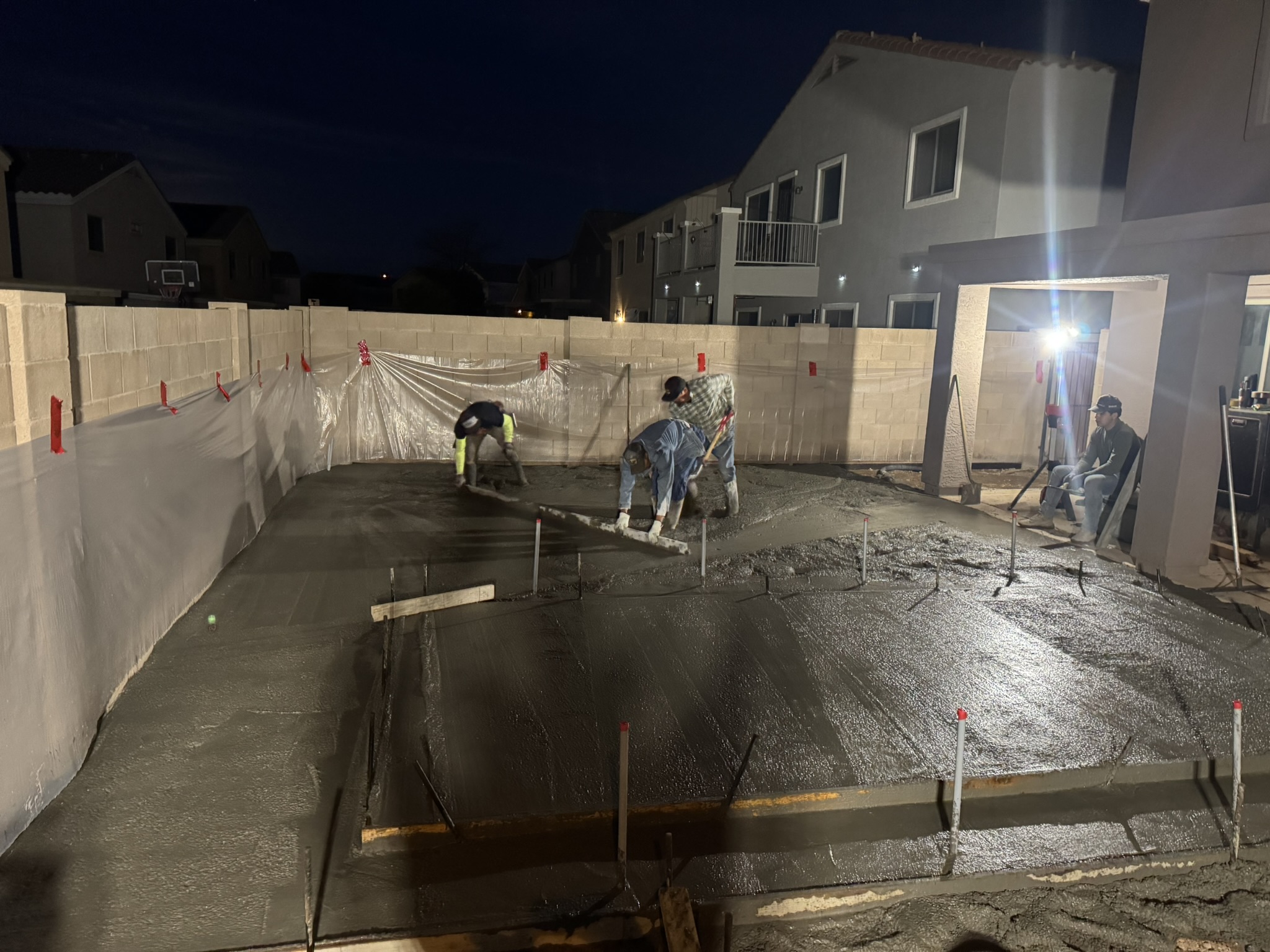
An experienced Arizona concrete contractor doesn't just pour and leave. Active curing management is what separates a 30-year driveway from one that's cracked and scaling within five years. Here are the specific techniques used on every Ares and Eros Contracting pour:
Early Morning Pours
All significant concrete pours in Arizona during summer months are scheduled for very early morning — ideally before 6 AM. This allows the initial finishing work to be completed before peak afternoon heat arrives and gives the concrete time to gain early strength before the most aggressive evaporation conditions of the day.
Retarding Admixtures
Retarding admixtures are chemical agents added to the concrete mix that slow the hydration reaction. In Arizona summer conditions, retarders extend the workable window from the 1–2 hours common in extreme heat to a more manageable 3–4 hours. This is standard practice on all Arizona summer pours — not an upgrade. Any contractor who isn't using retarders on a July pour in Glendale is cutting a critical corner.
Evaporation Retarders
Evaporation retarders are applied to the fresh concrete surface immediately after screeding and before finishing. They form a thin film that significantly slows moisture evaporation from the surface, buying the finisher critical extra time and reducing the risk of plastic shrinkage cracking — particularly important on windy days.
Wet Curing and Curing Blankets
After finishing is complete and the concrete has achieved initial set, wet curing begins. Burlap or specialized curing blankets are saturated with water and laid over the entire slab surface, then kept continuously moist for a minimum of 7 days. In Arizona's evaporation conditions, a dry burlap blanket is almost as bad as no blanket — continuous re-wetting is essential.
Curing Compounds
Where wet curing blankets are not practical, a liquid membrane-forming curing compound is applied immediately after finishing. The compound cures to form a film that retains moisture within the slab. Curing compounds must be applied at the correct rate and uniformly to be effective. They do not substitute for sealing — sealing is a separate, later step.
VETERAN-OWNED & ARIZONA LICENSED
Ares and Eros Contracting is a Service-Disabled Veteran-Owned Small Business (SDVOSB), Arizona ROC License #363389, fully licensed and insured for concrete contracting throughout Arizona. Every technique described in this article — early morning scheduling, retarders, evaporation retarders, wet curing, curing compounds — is standard practice on every pour we complete. Not an upgrade. Not an add-on. The standard.
5. Arizona-Specific Factors That Affect Your Concrete's Cure
Every Arizona concrete project faces a combination of environmental factors that no other US market deals with simultaneously.
Extreme Heat: Phoenix, Glendale, and the West Valley
The Phoenix metro — including Glendale, Goodyear, Surprise, and Avondale — regularly records ambient temperatures above 110°F from June through September, with extreme peaks above 115°F. Ground surface temperatures on exposed concrete can reach 160°F or higher. These conditions demand the full suite of heat mitigation techniques on every pour. A contractor who is "comfortable winging it" in these conditions is not the right contractor for your project.
Monsoon Season: July Through September
Arizona's monsoon season overlaps with the peak of summer heat. Monsoon storms can arrive within hours of a clear forecast and deliver 1–2 inches of rain in under 30 minutes. Rain on fresh concrete in the first 24–48 hours after placement dilutes the surface cement paste, permanently weakening the slab surface and causing crazing, scaling, and reduced wear resistance.
Experienced Arizona contractors monitor weather forecasts closely and will reschedule pours when monsoon activity is expected within 24 hours of placement. Never allow a contractor to pour concrete with active monsoon weather forecast.
Expansive Clay Soils: Glendale and the West Valley
The West Valley's expansive clay soils create a dynamic sub-base that shifts during Arizona's wet-dry cycles. During the curing period, fresh concrete is most vulnerable to sub-base movement. A properly compacted crushed aggregate sub-base is a structural necessity in Glendale and throughout the Phoenix metro — not optional. A slab curing over a destabilized base is more likely to develop early cracking that compromises the entire installation.
Intense UV Radiation Year-Round
Arizona's UV index is among the highest in the continental US. UV radiation degrades the cement paste at the surface over time, causing dusting, surface softening, and reduced abrasion resistance. Curing compounds provide early UV protection. A penetrating concrete sealer applied after the 28-day cure provides long-term protection. For Arizona driveways and patios, sealing every 2–3 years is the maintenance standard.
6. When to Seal Concrete After Curing in Arizona
Never seal concrete before 28 days. Sealing before the 28-day mark traps moisture and gases within the slab. This causes bubbling, blushing (white discoloration), and reduced sealer adhesion — meaning the sealer peels quickly and provides inadequate protection.
After 28 days, the appropriate sealer for Arizona driveways is a penetrating silane or siloxane sealer. Penetrating sealers absorb into the concrete matrix, repel moisture and chlorides from within, and are more durable in Arizona's UV environment than film-forming sealers, which can peel, yellow, and delaminate under intense sun.
Apply sealer in the fall — October through early November is ideal in the Phoenix metro. The combination of lower UV intensity and moderate temperatures gives the sealer optimal curing conditions. Applying sealer in direct midday summer sun causes it to flash-dry unevenly, significantly reducing effectiveness.
7. Common Curing Mistakes That Ruin Arizona Concrete
These are the most frequent curing errors seen on Arizona properties:
•Pouring in afternoon summer heat — the worst possible time to place concrete in Arizona
•Not using retarding admixtures in summer — without retarders, the workable window is too short for quality finishing
•Letting curing blankets dry out — in Arizona's evaporation conditions, blankets need re-wetting multiple times daily for at least 7 days
•Driving on the driveway at 24 hours — at only 16–20% of design strength, vehicle loads cause surface damage and cracking
•Sealing before 28 days — traps hydration gases, causes blushing and adhesion failure
•Ignoring the monsoon forecast — even a light shower on 12-hour-old concrete can permanently damage the surface
•Using a pressure washer in the first 30 days — removes cement paste from the surface before it has fully hardened
8. Frequently Asked Questions
1. How long does concrete take to cure in Arizona's heat?
Concrete reaches initial set in 2–4 hours in Arizona's summer heat and is safe to walk on within 24 hours. Full structural strength requires 28 days of active, properly managed curing. In Arizona, the curing process must be protected with evaporation retarders, wet curing blankets, and curing compounds because extreme heat causes rapid moisture loss that permanently weakens concrete if left uncontrolled.
2.Can you drive on concrete after 24 hours in Arizona?
No. At 24 hours, concrete has typically only reached 16–20% of its design strength. Wait a minimum of 7 days before light vehicle traffic and 28 days before regular vehicle use on Arizona driveways. Driving on concrete too early causes surface damage, cracking, and long-term structural weakness.
3.Does Arizona heat speed up or slow down concrete curing?
Arizona heat speeds up the initial set but creates serious curing problems. High temperatures accelerate the hydration reaction, causing concrete to set faster, but also cause rapid surface moisture evaporation. Without that moisture, hydration cannot complete and the concrete never reaches its full design strength.
4.When is the best time to pour concrete in Arizona?
Early morning (before 6–7 AM) during cooler months, October through April. During summer, very early morning pours with retarding admixtures are necessary. Monsoon season (July–September) requires careful weather monitoring. Never pour with active monsoon weather forecast within 24 hours of placement.
5.When can I seal my new concrete driveway in Arizona?
Wait a minimum of 28 days. Sealing earlier traps hydration gases and moisture, causing blushing, bubbling, and adhesion failure. After 28 days, apply sealer in October–November for best results. Avoid sealing in direct midday summer sun.
6. How do Arizona concrete contractors prevent heat-related curing problems?
Experienced Arizona contractors use: early morning pours before 6 AM in summer, retarding admixtures to extend the workable window, evaporation retarders applied immediately after screeding, continuously wetted curing blankets for at least 7 days, and curing compounds where blankets aren't practical. At Ares and Eros Contracting (ROC #363389), all of these are standard practice on every pour.
Ready for a Free Concrete Estimate in Phoenix or Glendale?
Ares and Eros Contracting is a veteran-owned (SDVOSB), ROC-licensed Arizona concrete contractor (ROC #363389). We manage every pour with the heat-adapted techniques your project requires, proper curing is included as standard. Serving Phoenix, Glendale, Goodyear, Surprise, Buckeye, Avondale, Scottsdale, Tempe, Mesa, Cave Creek, Queen Creek, Apache Junction, and Paradise Valley.
Get a Free Estimate: aaecontracting.com/contact/
About the Author
This article was written by the owner of Ares and Eros Contracting, a U.S. military veteran and Arizona-licensed concrete contractor (ROC #363389). After serving in the U.S. Armed Forces, he founded AAE to bring military-grade precision and accountability to concrete construction across the Phoenix metro. He and his team have poured hundreds of driveways, patios, foundations, and commercial slabs across Glendale, Phoenix, Goodyear, and the surrounding Valley, in every season, in every condition Arizona can produce.
The curing practices described in this article are not textbook recommendations. They are what AAE does, on every job, every time. Visit aaecontracting.com to learn more about our team and request a free estimate.
