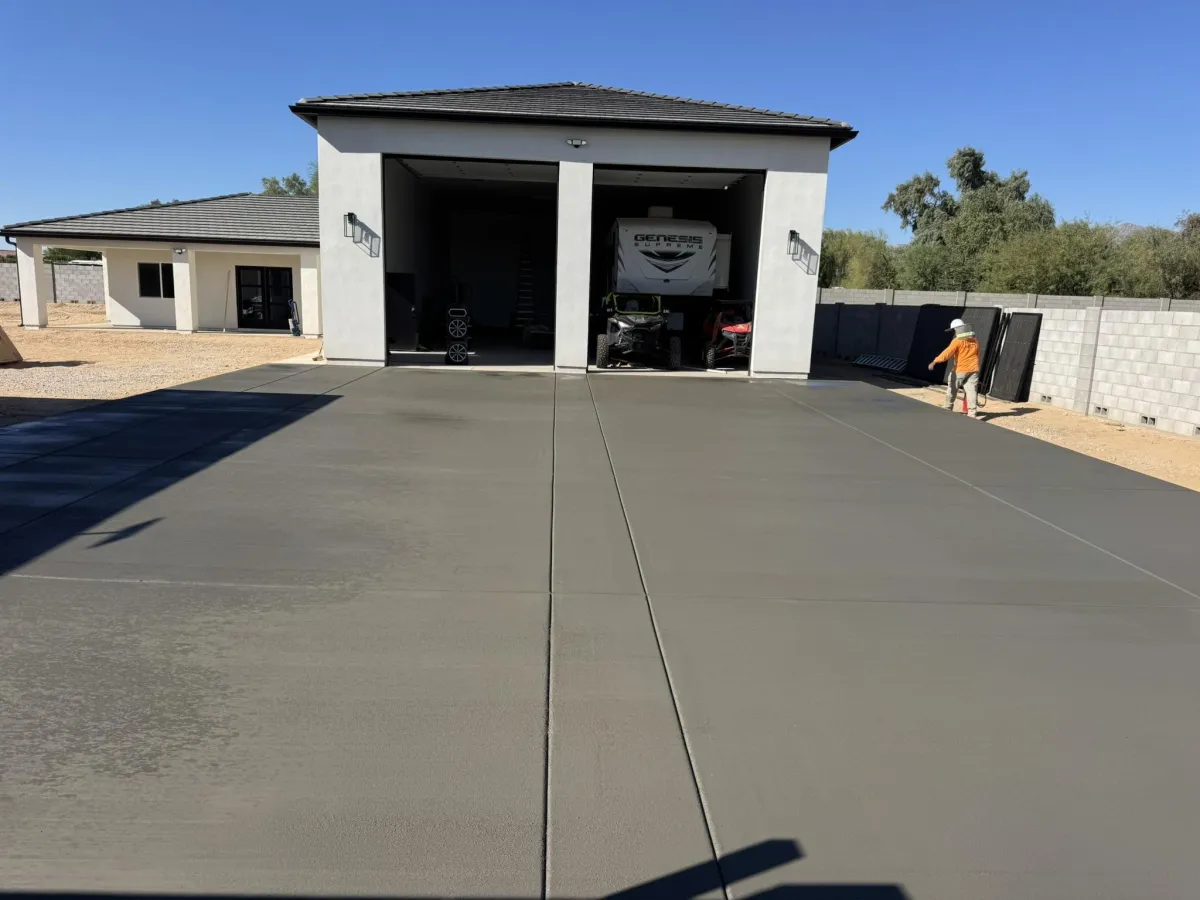
Asphalt vs Concrete Driveway in Arizona
If you're replacing or installing a new driveway in Phoenix, Scottsdale, Tempe, or anywhere across the Valley of the Sun, the concrete vs. asphalt decision matters more than it does anywhere else in the country. Arizona's extreme heat, expansive soils, and monsoon season create conditions that expose the weaknesses of the wrong material fast. This guide breaks down every factor — lifespan, cost, performance in heat, maintenance, and long-term value — so you can make an informed choice for your Arizona property.
1. Why Arizona Is a Different Playing Field
Most driveway comparison guides are written for climates with cold winters, moderate summers, and predictable rainfall. Arizona is none of those things. The Phoenix metro regularly records summer highs above 115°F, blacktop surface temperatures can hit 160°F or higher, the ground beneath your driveway is laced with expansive clay soils that shift with every rainfall, and monsoon season delivers intense downpours that overwhelm poorly designed drainage.
These conditions don’t just shorten driveway lifespans — they actively exploit weaknesses in material choice and installation quality. A driveway that would last 20 years in Dallas might fail in 8 years in Goodyear. Understanding how each material responds to Arizona’s specific stresses is the only way to make a rational decision.
Phoenix averages 299 sunny days per year, records ground temperatures above 140°F in summer, and receives 8 inches of annual rainfall — most of it in intense 30-minute monsoon bursts from July through September. No driveway material escapes these conditions unaffected.
2. Lifespan: How Long Does Each Material Last in Arizona?
Concrete Driveway Lifespan in Arizona
A properly installed concrete driveway in Arizona lasts 30 to 50 years with basic maintenance. Concrete is a rigid material — it doesn’t soften, deform, or rut in heat, which is the single most important quality in a market where ground temperatures regularly exceed 140°F. The primary enemies of concrete longevity in Arizona are expansive soil movement, improper curing during installation, and UV-driven surface degradation — all of which are manageable with proper installation.
Key installation factors that determine how long a concrete driveway lasts in Arizona:
Sub-base preparation: Arizona’s clay-heavy soils expand when wet and contract when dry, exerting pressure on slabs. A properly compacted crushed stone sub-base dampens this movement dramatically. Skipping this step is the most common reason concrete driveways fail prematurely in the Phoenix metro.
Slab thickness: The national standard 4-inch slab is undersized for Arizona. A minimum of 5 inches is recommended for residential driveways in the Valley, with heavy vehicle traffic warranting 6 inches. The additional thickness provides structural resilience and better resistance to cracking from soil movement.
Reinforcement: Rebar (typically #3 or #4 at 18-inch spacing) or welded wire mesh significantly extends slab life by holding cracks together even when soil movement occurs. Many low-bid contractors skip reinforcement. Don’t let yours.
Curing: In Arizona summers, fresh concrete can lose surface moisture within minutes of placement, causing plastic shrinkage cracks. Proper heat-adapted curing — using evaporation retarders, wet curing blankets, or curing compounds — is non-negotiable for a long-lived Arizona driveway.
Sealing: Applying a penetrating concrete sealer every 2–3 years protects against UV degradation and can add 10–15 years to your driveway’s service life.
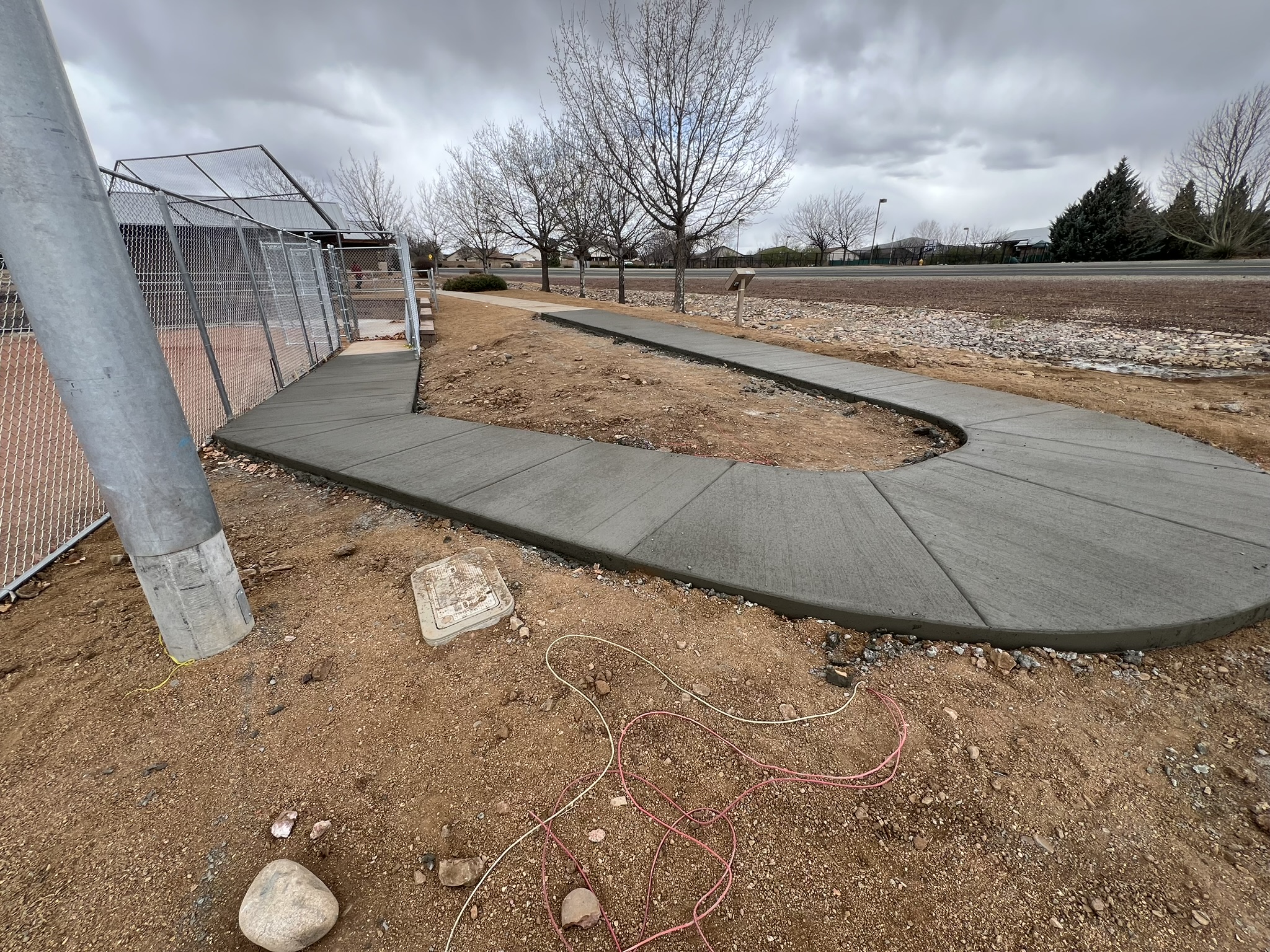
Asphalt Driveway Lifespan in Arizona
An asphalt driveway in Arizona typically lasts 10 to 20 years before requiring major work, with resurfacing needed every 5–7 years to maintain appearance and function. This is the observed reality from contractors and homeowners across Phoenix, Scottsdale, and Tempe.
The reason is simple chemistry: asphalt is a petroleum-based product with a relatively low softening point. In Arizona summers, where blacktop surface temperatures regularly exceed 150–160°F, asphalt transitions from a rigid pavement to a semi-plastic material. Vehicle tires press into the surface, leaving permanent ruts. Power steering marks appear at the ends of driveways. Oils and fluids from vehicles penetrate the softened surface far more readily.
Asphalt is also more porous than concrete, which means Arizona’s monsoon rains infiltrate more easily, eroding the base material and creating voids beneath the surface that eventually cause cracking and sinking. UV radiation breaks down the asphalt binder continuously, causing the surface to oxidize and become brittle.
At a glance: Concrete lasts 30–50 years in Arizona. Asphalt lasts 10–20 years and typically needs resurfacing every 5–7 years.
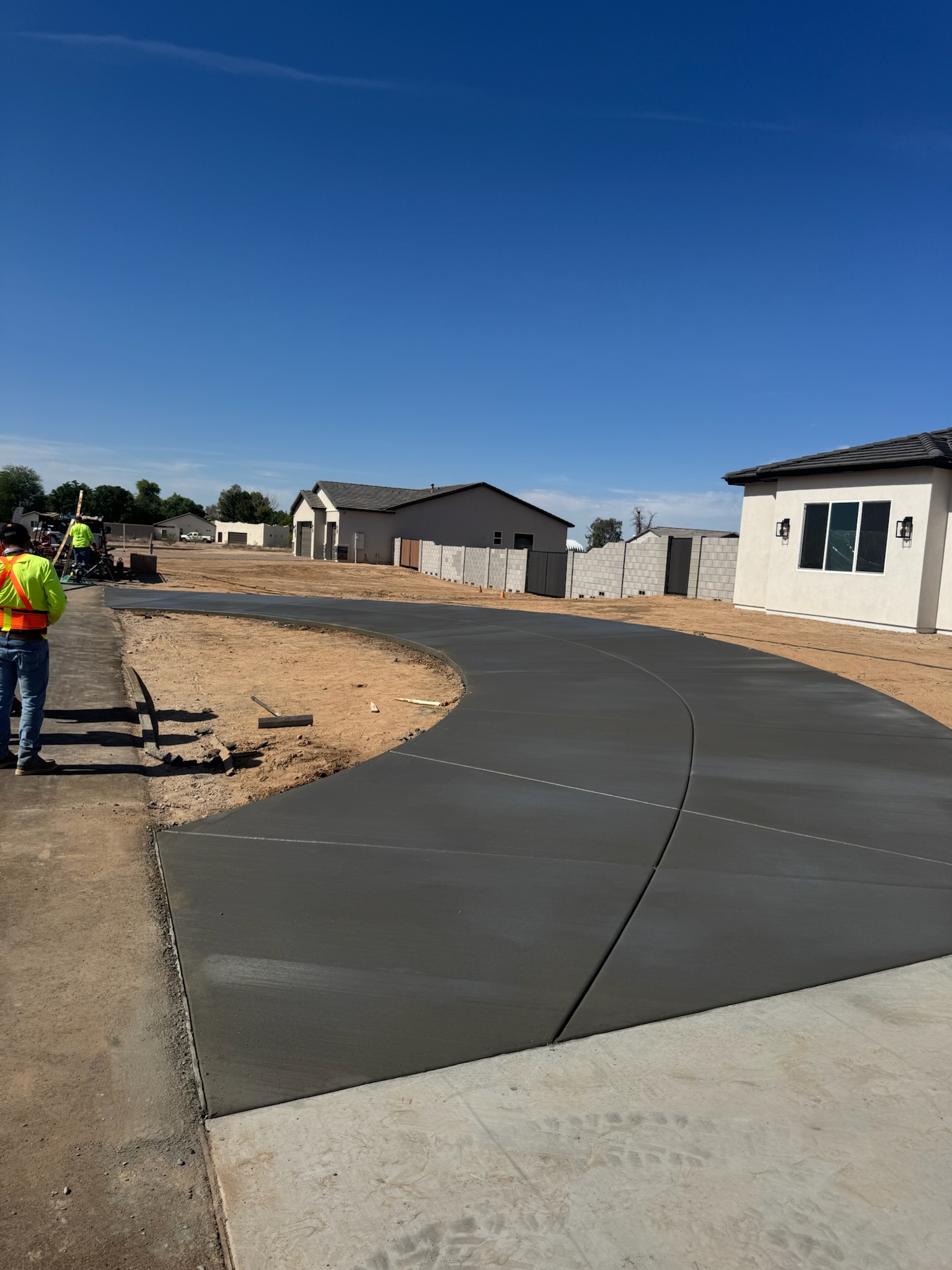
3. Heat Performance: The Arizona Differentiator
How Concrete Handles Arizona Heat
Concrete is a rigid, inorganic material. It doesn’t soften in heat — it expands slightly through thermal expansion, which is why proper control joint placement is essential, but it maintains its structural integrity at temperatures far beyond what Arizona’s climate produces. A concrete driveway in Buckeye at 118°F performs structurally identically to the same driveway at 70°F.
Concrete also absorbs less heat than dark-colored asphalt, which means a lighter-colored concrete driveway stays measurably cooler — an advantage that extends to the surrounding yard microclimate and reduces the urban heat island effect that intensifies conditions in Phoenix’s densest neighborhoods.
How Asphalt Handles Arizona Heat
Asphalt does not handle Arizona heat well. Asphalt concrete is an aggregate-binder composite where bitumen — a petroleum product — holds everything together. Bitumen’s viscosity decreases significantly with temperature. In Arizona’s summers, it regularly crosses the threshold from solid binder to semi-plastic material.
On a 115°F Phoenix summer day, asphalt surface temperatures can reach 160–170°F — well above asphalt’s typical softening point of 130–140°F. The practical consequences include: rutting under tire loads, tire-tracking marks at driveway ends, increased susceptibility to fuel and oil damage, and accelerated oxidation and brittleness in cooler months following extreme heat exposure.
4. Cost Comparison: Upfront vs. Lifetime
Upfront Installation Cost in Arizona (2025)
Concrete driveways cost more to install than asphalt. In Arizona’s current market, typical installation costs for a standard two-car residential driveway (approximately 600–800 sq ft) are:
Concrete: $6–$12 per sq ft installed, or $4,200–$8,400 for a typical 700 sq ft driveway.
Asphalt: $3–$6 per sq ft installed, or $2,100–$4,200 for a typical 700 sq ft driveway.
Prices vary based on soil conditions, site access, thickness requirements, and finish selections. Contact us for a free on-site estimate specific to your Arizona property.
Lifetime Cost: Where Concrete Wins
The upfront cost comparison tells only part of the story. When you factor in the ongoing maintenance and replacement costs over 30 years, concrete almost always costs significantly less in Arizona. Consider an approximate 30-year cost scenario for a 700 sq ft driveway:
Concrete — 30-year total: ~$7,300. Initial install ~$6,300, crack sealing ~$400, periodic sealing ~$600. No resurfacing or replacement needed.
Asphalt — 30-year total: ~$12,250+. Initial install ~$3,150, resurfacing twice ~$3,500, crack sealing ~$1,200, periodic sealing ~$900, replacement at end of life ~$3,500+.
Despite a higher upfront investment, concrete’s dramatically longer service life and lower maintenance requirements make it roughly 40% less expensive over 30 years in Arizona. The gap widens compared to cooler climates because asphalt’s maintenance cycle accelerates in extreme heat.
5. Maintenance Requirements in Arizona’s Climate
Concrete Driveway Maintenance
Sealing (every 2–3 years): Apply a penetrating concrete sealer to protect against UV degradation and moisture penetration. In Arizona’s high-UV environment this is the single most impactful maintenance step. Apply in spring or fall when temperatures are between 50–90°F.
Crack monitoring: Inspect annually. Hairline cracks under 1/8 inch are cosmetic. Cracks wider than 1/4 inch, or any crack showing vertical displacement, warrant professional evaluation — particularly in Arizona where expansive soil movement can cause cracks to grow quickly.
Cleaning: Pressure wash once or twice per year to remove dust and caliche accumulation, and to spot early-stage cracking before it worsens.
Joint maintenance: Reseal control joints when existing sealant cracks or shrinks. Open joints allow water infiltration and weed growth, both of which accelerate deterioration.
Asphalt Driveway Maintenance
Seal coating (every 1–3 years): In Arizona’s UV environment, the lower end of this range — every 1–2 years — is appropriate for driveways in full sun. It replenishes the binder broken down by UV radiation and helps resist fuel and oil penetration.
Crack filling: Asphalt cracks develop faster in Arizona due to heat-cold cycling and UV oxidation. Cracks must be filled promptly — unsealed cracks allow monsoon water to reach the base material, causing erosion and voids that lead to potholing.
Resurfacing: Every 5–7 years in Arizona, a 1–2 inch overlay of fresh asphalt is typically needed to restore the surface. This adds significant cost and disruption over the driveway’s lifetime.
Edge maintenance: Asphalt edges are particularly vulnerable in Arizona. Without concrete edging or metal edge restraints, asphalt edges crumble from heat cycling, vehicle overrun, and monsoon water undercutting.
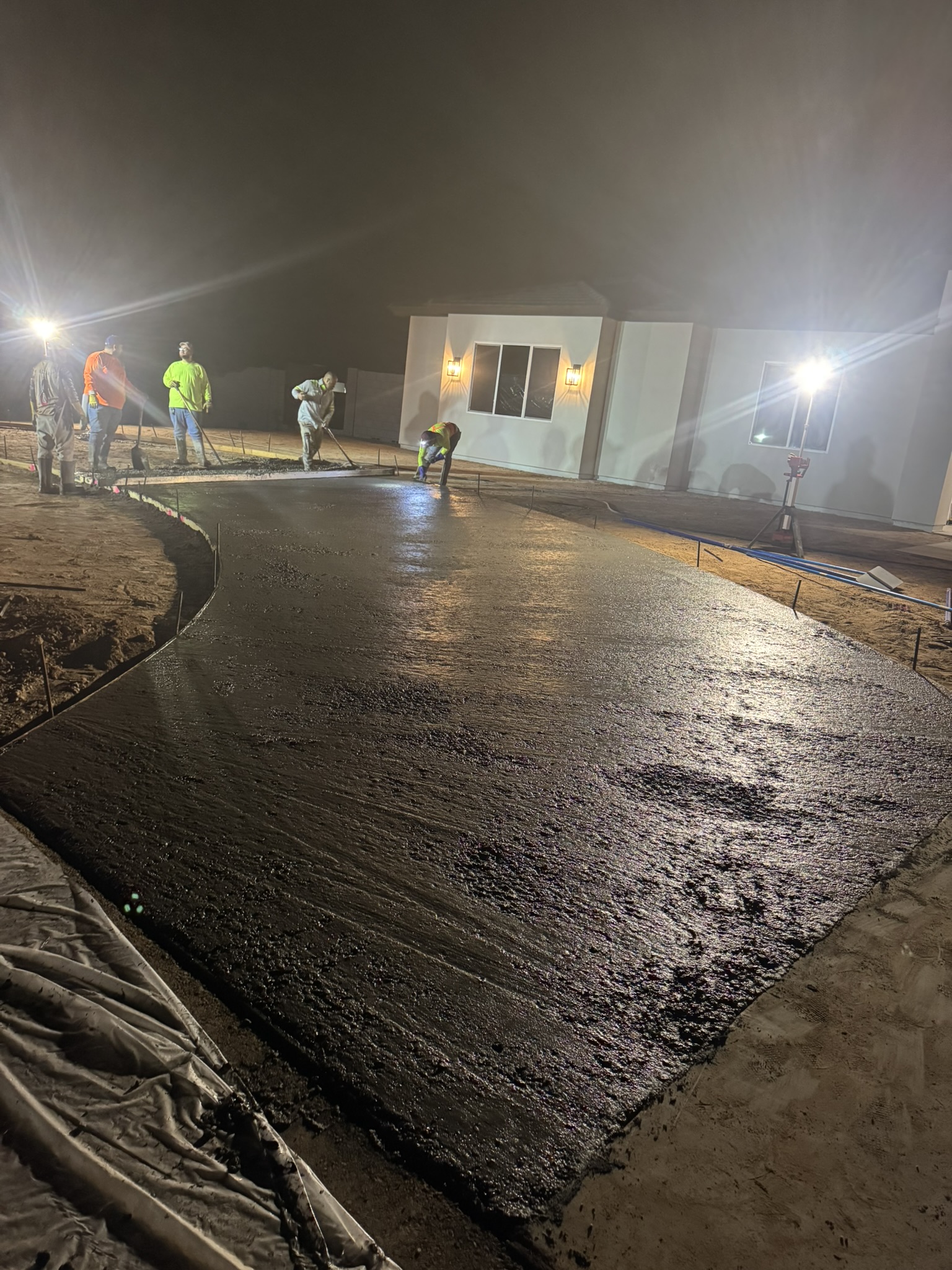
6. Monsoon Season Performance
Arizona’s monsoon season — July through September — delivers intense rainfall events that can drop 1–2 inches of rain in under an hour. Both driveway materials face real stress during this period, but they fail in different ways.
Concrete and Monsoons
Properly designed concrete driveways handle monsoon rain well. Concrete is a low-porosity material that doesn’t absorb significant water, so the primary concern is drainage design — ensuring water moves off the surface quickly via proper slope (a minimum 1–2% grade away from structures). Concrete with good joint maintenance and surface sealing resists water infiltration into the base material effectively.
Asphalt and Monsoons
Asphalt is more vulnerable to monsoon conditions. After a summer of UV oxidation and heat softening, the asphalt surface enters monsoon season in a weakened state. Cracks formed during summer heat now allow monsoon water to reach the aggregate base, eroding it and creating voids. The rapid temperature drop during monsoon storms — sometimes 30°F in minutes — causes additional thermal stress. Over multiple monsoon seasons, this cycle of heat damage followed by water infiltration is the primary mechanism by which Arizona asphalt driveways deteriorate.
Regardless of material, proper drainage design is the most important factor in driveway longevity in Arizona. A correctly sloped driveway that directs water away from the home and toward appropriate drainage is essential.
7. Arizona’s Expansive Soils: The Hidden Factor
Much of the Phoenix metro — including Phoenix, Mesa, Tempe, Scottsdale, Queen Creek, and Goodyear — sits on soils with significant expansive clay content. These soils swell when they absorb moisture and contract as they dry. The volume change can be substantial enough to exert significant upward and lateral pressure on driveways.
Expansive Soils & Concrete
Concrete’s rigidity makes it susceptible to cracking when expansive soils move beneath it. However, this risk is well-managed through proper engineering: a well-compacted granular sub-base (typically 4–6 inches of compacted crushed stone) isolates the concrete from direct soil contact and dampens movement. Adequate reinforcement ensures that even if minor cracking occurs, the slab holds together structurally. Post-tensioned concrete slabs, common in Arizona residential construction, are specifically engineered to resist expansive soil movement.
Expansive Soils & Asphalt
Asphalt’s flexible nature means it deforms rather than cracks when soils move — which sounds like an advantage until you realize that deformation in an asphalt driveway means ruts, waves, and surface distortions that worsen with each soil movement cycle. Significant soil expansion events can push asphalt surfaces into waves and humps that are difficult and expensive to correct.
8. Aesthetics and Home Value in Arizona
Appearance Over Time
New asphalt driveways have a clean, uniform black appearance — but that appearance fades quickly in Arizona. Within 1–2 years, UV oxidation turns black asphalt to a faded grey. Without regular sealcoating, the surface takes on a dry, weathered look. Concrete ages more gracefully, maintaining its appearance with less active effort. Light-colored concrete also complements Arizona’s sandy, desert architectural aesthetic better than asphalt’s urban appearance.
Design Versatility
Concrete offers significantly more design flexibility than asphalt. Options available to Arizona homeowners include:
•Broom finish — the standard, cost-effective choice
•Exposed aggregate — popular in Scottsdale and Paradise Valley
•Stamped concrete — mimicking stone, tile, or brick patterns
•Colored concrete — integral pigmentation that doesn’t fade like surface treatments
•Salt finish — a subtle texture popular for pool decks and patios
Impact on Home Resale Value
Concrete driveways contribute more positively to home resale value than asphalt driveways in Arizona’s market. Buyers in the Phoenix metro respond better to concrete driveways — a concrete driveway is a long-life asset that doesn’t require near-term replacement, while an aging asphalt driveway is often treated as a deferred maintenance liability by buyers and their inspectors.
9. City-by-City Considerations Across the Valley
Soil conditions, HOA requirements, municipal codes, and microclimate variations give the concrete vs. asphalt decision some city-specific nuance across the Phoenix metro.
Phoenix
Phoenix’s urban heat island effect makes asphalt’s heat absorption particularly problematic in central and inner-ring neighborhoods. Concrete is the clearly superior choice. Phoenix also has significant HOA presence in planned communities — most require concrete or prohibit asphalt entirely.
Scottsdale and Paradise Valley
Homeowners in Scottsdale and Paradise Valley nearly universally choose concrete. The aesthetic alignment with desert modern and Southwestern architecture is strong, and both cities’ high-value real estate markets reward quality materials. Custom finishes — exposed aggregate, stamped, or brushed concrete — are common in these markets.
Tempe and Mesa
Tempe and Mesa have some of the Valley’s heaviest clay soil concentrations, making proper sub-base preparation especially important regardless of material. Concrete’s structural advantages are more pronounced here.
Goodyear, Buckeye, and the West Valley
The West Valley’s rapid growth has created significant new construction activity in Goodyear, Buckeye, and Avondale. New construction in these markets almost exclusively uses concrete driveways — a reflection of HOA requirements and builder understanding of Arizona conditions.
Cave Creek and North Scottsdale
Desert hillside communities in Cave Creek and North Scottsdale often have significant grade changes, rocky soils, and architecturally driven requirements. Concrete’s design flexibility makes it the natural choice for these premium residential markets.
Queen Creek and Apache Junction
These outer East Valley communities often have larger lot sizes and longer driveways, meaning material choice has more pronounced cost and performance implications. Concrete’s longevity advantage is particularly compelling here.
10. When Does Asphalt Make Sense in Arizona?
In the interest of balance, there are scenarios where asphalt is a reasonable choice in Arizona, even given concrete’s significant advantages.
Short-term budget constraints: If upfront cost is the primary constraint and you understand the long-term trade-offs, asphalt’s lower initial price is real. Particularly relevant for investment properties where short-term cash flow matters more than 30-year optimization.
Very long driveways on rural properties: For properties with driveways exceeding 300–400 feet, the upfront cost difference becomes very large. Asphalt may be the practical option for long, functional access roads where aesthetics are less important.
Shaded northern exposures: Driveways in heavy shade spend significantly less time at extreme temperatures. Asphalt’s heat sensitivity is less pronounced — though this is uncommon in Arizona’s sun-dominated landscapes.
These exceptions represent the minority of Arizona residential driveway situations. For the typical Phoenix metro homeowner, concrete is the objectively superior choice by most meaningful measures.
11. Our Verdict
For virtually all Arizona homeowners across the Phoenix metro, concrete is the superior choice on every meaningful long-term measure: lifespan (30–50 years vs. 10–20), heat performance (rigid vs. softening), lifetime cost (lower total despite higher upfront), maintenance burden (low vs. high), design versatility, and home resale value contribution.
Arizona’s extreme heat makes asphalt’s inherent weaknesses — petroleum binder softening, UV oxidation, heat absorption — impossible to engineer around. Concrete’s weaknesses in Arizona, primarily susceptibility to expansive soil cracking, are fully manageable with proper installation techniques. The choice is clear.
If you’re planning a new driveway or replacing an existing one anywhere across the Phoenix metro — Phoenix, Mesa, Tempe, Scottsdale, Glendale, Goodyear, Buckeye, Surprise, Cave Creek, Queen Creek, Apache Junction, Avondale, or Paradise Valley — Ares and Eros Contracting installs concrete driveways engineered specifically for Arizona’s demanding climate.
12. Frequently Asked Questions
1.Does asphalt hold up in Arizona heat?
No — not well. Asphalt softens significantly in Arizona’s summer heat, which regularly exceeds 115°F in the Phoenix metro. Blacktop surface temperatures can reach 160°F or more, causing ruts, tire tracking, and accelerated degradation. Most Arizona asphalt driveways require resurfacing every 5–7 years as a result.
2. How long does a concrete driveway last in Arizona?
A properly installed concrete driveway in Arizona lasts 30–50 years with basic maintenance including periodic sealing every 2–3 years. Key factors are correct sub-base preparation for Arizona’s expansive clay soils, proper reinforcement, adequate slab thickness (5 inches minimum recommended), and heat-adapted curing during installation.
3. Concrete more expensive than asphalt in Arizona?
Concrete costs 20–40% more upfront. However, when you account for asphalt’s higher maintenance costs and shorter lifespan, concrete typically costs 30–40% less over a 30-year period in Arizona’s climate. The upfront premium pays for itself through reduced ongoing maintenance alone.
4.Which driveway material is better for Arizona’s monsoon season?
Concrete performs better. It has low porosity and resists moisture absorption with proper drainage design. Asphalt is more porous and susceptible to moisture infiltration, particularly at cracks and joints. After a summer of heat-related softening, Arizona asphalt enters monsoon season in a weakened state prone to accelerated cracking and base erosion.
5.What thickness should a concrete driveway be in Arizona?
A minimum of 5 inches, not the national standard 4 inches, for residential driveways in Arizona. The extra inch provides meaningfully better resistance to cracking from expansive soil movement throughout the Phoenix metro. For driveways accommodating heavy vehicles, 6 inches is the appropriate specification.
6.Does concrete crack in Arizona heat?
Concrete expands and contracts with temperature changes, which is why control joints are placed at regular intervals during installation — these give the concrete a predetermined place to crack, keeping cracks controlled and non-structural. Random uncontrolled cracking is caused by inadequate reinforcement or poor sub-base preparation, not by Arizona’s heat itself.
7.Can I seal a concrete driveway in Arizona summer?
Not recommended. Concrete sealer should be applied when temperatures are between 50–90°F with no rain expected for 24 hours. In Arizona, the ideal sealing windows are October through April. Applying sealer in direct midday summer sun causes it to dry too fast, resulting in uneven coverage and reduced penetration.
About Ares & Eros Contracting
Ares and Eros Contracting is a veteran-owned concrete construction company serving Phoenix, Mesa, Tempe, Buckeye, Avondale, Glendale, Goodyear, Surprise, Cave Creek, Scottsdale, Queen Creek, Apache Junction, Paradise Valley, and all of Arizona. We specialize in concrete slab and slab-on-grade foundations, structural foundations, sidewalks, curbs, curb and gutter, patios, driveways, concrete paving, and Portland Cement Concrete Pavement (PCCP).
From new construction and site development to infrastructure improvements, our team delivers precision workmanship and long-lasting results built for Arizona’s demanding desert climate.
