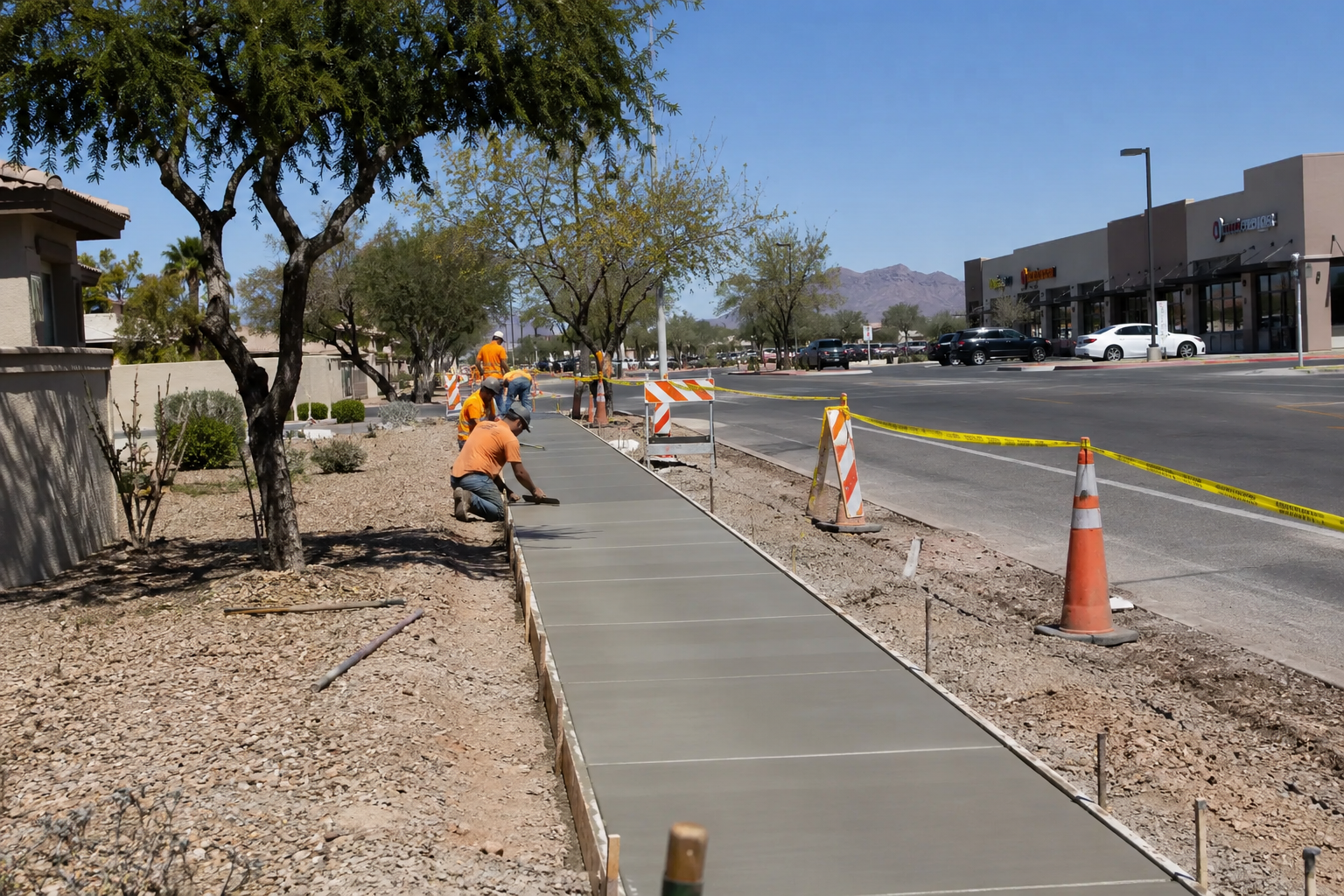
Concrete Sidewalk Thickness in Buckeye, AZ | AAE Contracting
Concrete sidewalks need to be thick enough to support their intended use, withstand regular foot traffic, and remain stable under changing outdoor conditions. For property owners in Buckeye, AZ, choosing the right sidewalk thickness is an important part of planning a durable walkway. A residential path leading to a front door may have different requirements from a commercial sidewalk that experiences frequent pedestrian traffic or connects to a parking area.
A thickness of approximately 4 inches is commonly used as a starting point for standard pedestrian sidewalks. However, that measurement should not automatically be applied to every property. The right thickness depends on the sidewalk's purpose, the condition of the ground beneath it, expected loading, drainage, reinforcement requirements, and applicable local standards.
Understanding these factors can help property owners make better decisions before beginning a concrete sidewalk project.
Is 4 Inches Thick Enough for a Concrete Sidewalk?
For many standard residential walkways intended primarily for pedestrian use, a 4-inch concrete slab is a common construction baseline. This thickness is generally intended for people walking across the surface rather than vehicles driving over it. When the ground is properly prepared and the concrete is installed with appropriate joints and drainage, a sidewalk of this thickness can provide a practical walking surface.
However, 4 inches is not a universal requirement for every sidewalk. A walkway near a driveway, loading area, or commercial entrance may experience additional stress. If vehicles occasionally cross the concrete, the design may need to account for those loads rather than relying on a typical pedestrian-walkway specification.
Property owners should also distinguish between concrete thickness and walkway width. Thickness describes the depth of the concrete slab, while width determines how much room people have to walk. Both measurements matter when planning a safe and functional sidewalk.
What Determines the Required Sidewalk Thickness?
Several conditions influence how thick a concrete sidewalk should be. Looking at these factors before installation helps prevent a design that is unsuitable for the property's actual use.
1. Residential or Commercial Use
Residential sidewalks usually serve a limited number of pedestrians throughout the day. A walkway connecting a driveway, front entrance, backyard, or outdoor living space may not require the same design considerations as a commercial sidewalk outside a retail property or office building.
Commercial walkways may experience heavier and more frequent foot traffic. They may also connect to areas where maintenance vehicles, delivery equipment, or other loads could affect the concrete. The planned use should be established before choosing the slab thickness and reinforcement approach.
2. Expected Weight and Traffic
A sidewalk designed for pedestrian traffic should not automatically be treated as suitable for vehicle traffic. Repeated vehicle loading can create stresses that a standard walkway design may not be intended to withstand.
This is particularly important near driveways, parking spaces, loading zones, and service entrances. If a vehicle will cross the sidewalk regularly, the contractor should evaluate the expected load and design the concrete section accordingly.
3. Soil and Subgrade Preparation
The ground beneath a concrete sidewalk plays a major role in how well the finished surface performs. Concrete needs consistent support from the prepared subgrade. If the soil is loose, poorly compacted, unstable, or uneven, sections of the sidewalk may settle or crack as the ground shifts.
Before concrete is placed, the installation area should be evaluated and prepared. Depending on site conditions, this may involve removing unsuitable material, grading the area, and compacting the subgrade. Increasing concrete thickness alone will not correct an improperly prepared base.
4. Drainage and Surface Slope
Water should drain away from the sidewalk and nearby structures without creating unwanted pooling or erosion. Poor drainage can soften or wash away supporting material beneath the concrete, contributing to movement and damage.
The sidewalk's slope should also support safe pedestrian movement. Walkways that connect to streets, driveways, entrances, or accessible routes may have additional design requirements. These should be considered before the concrete is poured rather than corrected after installation.
5. Reinforcement and Joint Placement
Reinforcement and control joints can be part of a sidewalk installation plan, depending on the project's design and conditions. Reinforcement may help manage cracking and maintain the relationship between concrete sections, but it does not eliminate all cracking.
Control joints create planned locations where shrinkage-related cracking can occur. Their placement, depth, and spacing should be appropriate for the sidewalk's dimensions and construction details.
Are Commercial Concrete Sidewalks Different From Residential Sidewalks?
They can be. The main difference is not simply that commercial sidewalks must always be thicker. Commercial properties may have more demanding pedestrian use, accessibility requirements, connections to public walkways, and additional loading conditions.
For example, a sidewalk outside a small office may serve mostly employees and visitors. A walkway near a shopping center entrance could experience much heavier daily traffic. A commercial property with delivery access may also need to account for service vehicles crossing areas that would otherwise be designed for pedestrians.
The property's location matters, too. Sidewalks constructed within a public right-of-way or as part of a development project may need to follow municipal engineering standards and approved construction details.
Property owners in Buckeye should review the city's current Engineering Design Standards and Details when a project involves public improvements or work subject to city requirements. The applicable standards and approved plans should determine the construction details for those projects.
Why Proper Base Preparation Matters as Much as Concrete Thickness
Choosing an appropriate thickness is only one part of building a reliable sidewalk. The supporting ground must also be able to carry the concrete without excessive movement.
If a contractor pours concrete over loose soil, organic material, or an inadequately prepared base, the slab may become uneven as the supporting material settles. This can lead to cracks, raised edges, or sections that no longer meet smoothly.
Grading is another important part of preparation. The base should provide consistent support while allowing the finished sidewalk to drain appropriately. Water that repeatedly collects along the walkway can contribute to erosion and create maintenance concerns.
A properly planned installation considers the concrete, the supporting base, the joints, and the surrounding grade as parts of the same system. Focusing only on slab thickness can overlook problems that affect the sidewalk's long-term performance.
What Should Buckeye Property Owners Consider Before Installing a Sidewalk?
Before scheduling concrete sidewalk construction, property owners should consider how the walkway will be used and where it will be installed. A residential path, a commercial pedestrian route, and a sidewalk connecting to a public street may each involve different requirements.
Start by identifying whether the walkway will carry pedestrians only or whether vehicles may cross it. Next, evaluate the ground conditions, drainage patterns, and connections to nearby driveways or structures. If the project is part of a commercial development or public improvement, review the applicable plans and local standards before construction.
It is also important to consider accessibility and pedestrian safety. Sidewalk width, slope, surface condition, transitions, and clear walking space can affect how comfortably people use the route. A sidewalk should be planned as a complete pedestrian surface, not simply as a strip of concrete.
Working with an experienced concrete contractor can help property owners determine which construction details are appropriate for the project.
Frequently Asked Questions
Is 4 inches the standard thickness for a residential concrete sidewalk?
Four inches is a common starting point for standard residential pedestrian sidewalks. However, the appropriate thickness depends on the intended use, ground conditions, loading, and any applicable local requirements.
Should a commercial sidewalk be thicker than a residential sidewalk?
Not automatically. Commercial sidewalks may experience greater pedestrian traffic or additional loading, but the required thickness should be based on the property's use and project specifications rather than the residential or commercial label alone.
Can vehicles drive over a 4-inch concrete sidewalk?
A typical pedestrian sidewalk should not automatically be considered suitable for vehicle traffic. Areas where vehicles regularly cross may require a different concrete design to account for the additional loading.
Does thicker concrete prevent sidewalk cracking?
Greater thickness by itself does not guarantee a crack-free sidewalk. Subgrade preparation, drainage, joint placement, concrete installation, and curing all influence how the finished surface performs.
Do concrete sidewalks in Buckeye need to follow city standards?
Projects involving public rights-of-way, city improvements, or other regulated construction may need to follow applicable Buckeye engineering standards and approved details. Property owners should verify the requirements for their specific project before work begins.
Plan Your Concrete Sidewalk Installation in Buckeye, AZ
A concrete sidewalk should be designed around its intended use, site conditions, and applicable construction requirements. Whether you are installing a residential walkway or planning a commercial pedestrian route, choosing an appropriate thickness and preparing the base correctly can help support a more durable finished surface.
AAE Contracting provides concrete construction services for property owners and projects in Arizona. Visit AAE Contracting to learn more about its work, explore its services, or contact the team to discuss your concrete sidewalk project in Buckeye, AZ.
ARTICLE 3
Meta Title: Concrete Curb and Gutter Repair or Replacement in Surprise, AZ | AAE Contracting
Meta Description: Learn when to repair or replace damaged concrete curbs and gutters in Surprise, AZ. Identify warning signs, drainage concerns, and factors that affect the right solution.
Primary Keyword: concrete curb and gutter repair Surprise AZ
Secondary Keywords: concrete curb replacement Surprise AZ, curb and gutter contractor Surprise AZ, damaged concrete curb repair, concrete gutter replacement Arizona, commercial curb and gutter repair
Suggested URL Slug: /concrete-curb-gutter-repair-replacement-surprise-az
Image Alt Tag: Concrete curb and gutter along a residential street in Surprise, Arizona
When Should You Repair or Replace Damaged Concrete Curbs and Gutters in Surprise, AZ?
Concrete curbs and gutters do more than create a finished edge along a driveway, parking lot, or roadway. They help define pavement boundaries, guide surface water, and support the overall layout of paved areas. When these features become cracked, broken, or uneven, the damage can affect both appearance and drainage.
For property owners and managers in Surprise, AZ, deciding whether to repair or replace damaged concrete curbs and gutters depends on the extent of the deterioration and how well the existing structure still functions. A small, isolated area of damage may be suitable for localized repair. Widespread cracking, significant displacement, or recurring drainage problems may indicate that replacement is the more practical solution.
Recognizing the difference can help property owners address concrete problems before they create larger maintenance concerns.
What Causes Concrete Curbs and Gutters to Crack or Deteriorate?
Curbs and gutters are exposed to regular outdoor conditions, vehicle contact, water flow, and movement in the supporting ground. Over time, these factors can contribute to damage.
1. Soil Movement and Settlement
Concrete needs consistent support beneath it. If the soil under a curb or gutter settles, shifts, or becomes unstable, sections of concrete may move out of alignment.
Settlement can create uneven edges, cracks, or gaps between concrete sections. In some cases, a curb may begin to lean or sink, affecting the way it meets the pavement.
Repairing the visible crack without addressing the underlying support problem may not resolve the cause. The area should be evaluated to determine whether the damage is isolated or part of a larger settlement issue.
2. Water Flow and Drainage Problems
Gutters are designed to help direct surface water along a planned path. When concrete sections become damaged or uneven, water may collect in areas where it should otherwise flow away.
Repeated water accumulation can contribute to erosion around the concrete and may affect the supporting material beneath it. Drainage problems can also make an existing crack or displaced section more noticeable over time.
If a curb and gutter system is no longer directing water properly, the repair should address the concrete's alignment and drainage function rather than only its appearance.
3. Vehicle Impact
Curbs near driveways, parking spaces, loading zones, and intersections can experience repeated contact from vehicles. A vehicle striking a curb can chip an edge, break off a section, or cause more extensive cracking.
A single impact may create localized damage that can be repaired. However, repeated impacts or damage that extends through multiple sections may make replacement a better option.
4. Concrete Deterioration
Concrete surfaces can develop cracks, scaling, spalling, or other forms of deterioration as they age and experience environmental exposure. The severity and location of the damage help determine whether the concrete can remain in service.
Minor surface deterioration may not require full replacement. More extensive deterioration, especially when it affects the curb's shape or the gutter's ability to carry water, may require a larger repair.
5. Poor Installation or Inadequate Support
Problems that originate during construction can become visible later. Inadequate base preparation, inconsistent support, improper drainage, or construction that does not follow the project specifications may contribute to premature movement or damage.
When similar problems appear repeatedly along the same curb line, it is worth investigating whether the issue involves the supporting base, drainage design, or installation rather than treating each damaged spot separately.
When Is Concrete Curb and Gutter Repair Enough?
Repair may be appropriate when the damage is limited to a small area and the surrounding concrete remains stable. The existing curb or gutter should still be properly aligned and capable of performing its intended function.
For example, a small chipped section caused by a minor vehicle impact may be a candidate for localized repair. An isolated crack may also be manageable when it has not caused significant movement or disrupted drainage.
Before recommending a repair, the damaged section should be evaluated for the condition of the surrounding concrete and the support beneath it. If the area is stable and the defect is limited, a targeted repair may restore the affected section without removing the entire curb or gutter run.
However, not every visible crack should be treated as a minor cosmetic issue. A crack accompanied by sinking, separation, or repeated water accumulation may indicate a deeper problem.
When Should Damaged Curbs and Gutters Be Replaced?
Replacement may be more appropriate when the concrete has deteriorated beyond the point where a localized repair can provide a reliable result. It may also be necessary when the original curb or gutter no longer maintains the correct alignment or drainage path.
Common signs that replacement should be considered include:
Widespread cracking: Multiple cracks across several sections may indicate extensive deterioration or movement.
Significant settlement: A curb or gutter that has sunk or shifted may no longer provide the intended elevation and support.
Repeated repair failures: If the same area continues to crack or separate after repairs, the underlying condition may not have been resolved.
Broken or missing sections: Large sections of concrete that have broken away may be difficult to restore with a small patch.
Drainage problems: Concrete that no longer directs water along the intended path may need reconstruction to restore proper flow.
Extensive surface deterioration: Severe scaling, spalling, or damage that affects multiple sections may make replacement more practical than repeated repairs.
Replacement can also be appropriate when a property owner is already planning broader pavement or site improvements. Coordinating curb and gutter work with nearby concrete or paving projects may help create a consistent finished layout.
How Can You Tell Whether the Damage Is Structural or Cosmetic?
The appearance of the damage provides some clues, but a visual inspection alone may not be enough to determine the right solution.
A shallow chip or small surface defect may be primarily cosmetic. A crack that runs through a section, separates concrete from an adjacent surface, or appears alongside a change in elevation may indicate a more significant issue.
The surrounding area should also be examined. If the concrete has moved, the soil has washed away, or water consistently collects beside the damaged section, the problem may involve the supporting ground or drainage.
The most useful evaluation considers the curb and gutter as a functional system. A repair should not only improve the appearance of the concrete; it should also restore the section's intended alignment, stability, and water-flow function.
Why Drainage Should Be Considered Before Repairing a Gutter
A concrete gutter has a practical purpose: it helps direct surface water along a planned route. This means the finished elevation and slope matter just as much as the condition of the concrete itself.
A replacement section that does not match the surrounding gutter's grade can create a low spot where water collects. Likewise, repairing a crack without correcting a related settlement issue may leave the drainage problem unresolved.
Before work begins, the affected section should be evaluated in relation to adjacent pavement, curbs, nearby drainage structures, and the property's overall grading. The repair or replacement should maintain the intended flow path and avoid creating new pooling areas.
For commercial properties, this is particularly important in parking lots and other paved areas where water accumulation can interfere with vehicle movement and pedestrian access.
Do Concrete Curb and Gutter Projects in Surprise Need to Follow Local Standards?
Requirements depend on the property's location and the scope of work. A privately owned curb within a property's boundaries may be subject to different requirements from a curb or gutter located in a public right-of-way.
Projects involving public infrastructure, streets, or other regulated improvements may need to follow city engineering standards, approved details, and permit requirements. Property owners should not assume that a repair can proceed without approval simply because the damaged area is relatively small.
The City of Surprise publishes its Engineering Development Standards for infrastructure planning and design. These standards are relevant when determining the requirements for applicable public and private infrastructure projects.
Before replacing or modifying concrete near a street, driveway connection, or public sidewalk, confirm which approvals and construction details apply to the specific location.
What Should You Consider Before Choosing Repair or Replacement?
The decision should start with the extent of the damage and the condition of the surrounding concrete. A localized defect in an otherwise stable curb may not require full replacement. On the other hand, widespread damage or a recurring drainage problem may make repeated patching an inefficient long-term approach.
Property owners should also consider the cause of the damage. If the supporting soil is unstable or water is washing material away from beneath the concrete, the underlying issue should be addressed as part of the work.
The location of the curb and gutter matters, too. A residential driveway edge, a commercial parking lot, and a section of roadway may have different loading conditions and construction requirements.
A qualified concrete contractor can evaluate the affected area, identify visible signs of movement or deterioration, and recommend whether a localized repair or broader replacement is more appropriate.
Frequently Asked Questions
Can a cracked concrete curb be repaired without replacing the entire section?
Yes, depending on the size, location, and cause of the crack. Localized repairs may be suitable when the surrounding concrete is stable and the damage has not affected the curb's alignment or function. Cracks associated with settlement or extensive deterioration may require a more comprehensive solution.
How do I know if a concrete gutter needs replacement?
Replacement may be necessary when the gutter has widespread cracking, significant settlement, broken sections, or drainage problems that cannot be corrected with a localized repair. A site evaluation can help determine the extent of the damage.
What happens if a damaged curb and gutter are left unrepaired?
Continued deterioration may lead to more extensive cracking, displacement, or erosion around the concrete. Damaged gutters may also allow water to collect or flow differently from the intended drainage path. The potential consequences depend on the location and severity of the damage.
Does replacing a concrete curb also require replacing the gutter?
Not always. The decision depends on how the two components are constructed, the extent of the damage, and whether the existing gutter can still function properly. If damage affects both components or the alignment, replacing a larger section may be more appropriate.
Are curb and gutter repairs different for commercial properties?
They can be. Commercial properties may have heavier vehicle traffic, larger paved areas, delivery access points, and more demanding drainage requirements. The repair or replacement plan should account for how the area is used and the applicable project specifications.
Schedule a Concrete Curb and Gutter Evaluation in Surprise, AZ
Damaged concrete curbs and gutters should be evaluated based on more than their visible appearance. Cracking, settlement, surface deterioration, and drainage problems can all affect whether a localized repair is sufficient or whether replacement is the more appropriate solution.
AAE Contracting provides concrete construction services for properties and projects in Arizona. Visit AAE Contracting to learn more about its work, explore its services, or contact the team to discuss concrete curb and gutter work in Surprise, AZ.
