How Long Does Concrete Paving Installation Take in Tempe, AZ? | AAE
Planning a concrete paving project in Tempe, Arizona, involves more than choosing an installation date and arranging for concrete delivery. The total schedule depends on the size of the paved area, the condition of the existing ground, the amount of demolition required, the selected concrete specifications, and the time needed to protect the finished pavement while it develops strength. Local weather and any required permits or inspections can also affect when construction begins and when the paved area can be used.
For homeowners, property managers, developers, and business owners, understanding the installation process helps establish realistic expectations before work starts. A relatively small paved area with straightforward site conditions may require only a few working days of active construction, while a large commercial parking lot or industrial paving project may require several phases spread over a longer period. Concrete curing and restrictions on vehicle traffic add another consideration that should be included in the schedule.
Ares & Eros Contracting (AAE) provides residential, commercial, and municipal concrete construction services throughout its Arizona service area, including concrete paving, slabs, driveways, sidewalks, curbs, and foundations. Understanding the stages involved in concrete paving can help Tempe property owners plan around construction activity, access restrictions, and the time needed before the new surface is ready for its intended use.
What Is the Typical Timeline for Concrete Paving Installation in Tempe?
There is no single installation timeline that applies to every concrete paving project. The amount of time required depends on how much pavement must be constructed, the work needed to prepare the site, the complexity of the layout, and whether the project must remain operational during construction.
For a small, uncomplicated paving project, active construction may fit within several working days once the site is ready and the work is approved to proceed. A larger commercial project may require more time because of demolition, excavation, base preparation, forming, reinforcement, drainage work, concrete placement, and the need to complete different sections in sequence. Projects that require engineering revisions, utility coordination, or municipal approvals may have a preconstruction period that extends beyond the physical installation.
It is also important to distinguish installation time from curing time. The paving crew may finish placing and texturing the concrete in a relatively short period, but that does not mean the pavement can immediately carry vehicles or heavy equipment. The appropriate opening date depends on the concrete's strength development and the project's specifications.
A realistic schedule should therefore identify the expected construction phases, anticipated completion date, and requirements for reopening the pavement. Property owners can use this information to coordinate parking, deliveries, pedestrian access, and other activities affected by the work.
What Factors Affect the Concrete Paving Installation Schedule?
Several conditions can influence how long a concrete paving contractor needs to complete a project. Evaluating these factors before construction begins makes it easier to develop a practical schedule and identify potential delays.
Size and Layout of the Paved Area
The amount of concrete being installed is one of the most obvious factors affecting project duration. A small residential parking area generally involves less forming, concrete placement, and finishing than a commercial parking lot or an extensive paved yard.
However, square footage alone does not determine the schedule. A large, open area with straightforward access may be easier to construct than a smaller site with tight working space, numerous edges, complicated drainage features, or multiple adjoining surfaces. Slopes, transitions, utility structures, and irregular boundaries can increase the amount of layout and finishing work required.
A contractor should evaluate the actual site rather than estimate the schedule based only on the amount of concrete. Establishing the pavement dimensions, elevations, access routes, and construction sequence before work begins helps the crew prepare the appropriate materials, equipment, and staffing.
Existing Pavement and Site Preparation
A project involving new construction on a prepared site may have different requirements from one that involves removing deteriorated pavement. Existing concrete may need to be saw-cut, broken apart, removed, and transported away before excavation and grading can begin.
The exposed ground must then be evaluated to determine whether it provides appropriate support for the proposed pavement. Depending on the conditions, preparation may involve removing unsuitable material, correcting elevations, compacting the subgrade, and installing a specified aggregate base.
Unexpected soil conditions or the discovery of buried utilities can affect the schedule because the original plan may need to be adjusted. Addressing these issues before concrete placement is important because paving over inadequate support can increase the risk of settlement and cracking. A reliable estimate should allow for the preparation work identified during the site evaluation.
Concrete Specifications and Construction Details
Concrete paving is designed for its intended use, so a residential paved area and a commercial parking lot may require different construction details. Thickness, concrete mixture, reinforcement, joint layout, edge conditions, drainage, and anticipated loading all influence the work involved.
Commercial paving may also include designated loading zones, accessible routes, transitions to existing pavement, utility access areas, and other features that require precise coordination. The greater the number of details that must be completed, the more important it becomes to plan the work sequence carefully.
The American Concrete Institute's guidance for concrete parking lots and site paving addresses areas such as subgrade preparation, base materials, concrete placement, finishing, jointing, curing, inspections, and opening to traffic. These requirements illustrate why a paving schedule should account for the complete construction process rather than the concrete pour alone.
What Are the Main Stages of Concrete Paving Installation?
Understanding the construction sequence helps explain why a paving project may remain in progress even when no concrete is visible at the jobsite. Each stage prepares the surface for the next and contributes to the finished pavement's performance.
Stage 1: Site Assessment and Project Planning
The process begins with reviewing the proposed paving area, determining its intended use, assessing access, and identifying site conditions that may affect construction. The contractor may evaluate the existing surface, soil support, elevations, drainage, utilities, and connections to adjoining pavement.
The design and specifications should also account for the vehicles or equipment expected to use the area. Residential parking, commercial vehicle access, and industrial paving can have substantially different loading requirements. Establishing those requirements early helps avoid changes to the construction scope after work begins.
If approvals, engineered plans, utility coordination, or other preconstruction activities are required, those items should be addressed before the installation date is finalized. A project schedule that includes only the days spent placing concrete can underestimate the actual time needed to complete the work.
Stage 2: Demolition, Excavation, and Ground Preparation
When existing pavement must be removed, the demolition and disposal work generally take place before the new surface is constructed. The contractor then prepares the site to the elevations and dimensions established for the project.
This may involve excavation, grading, removal of unsuitable material, moisture conditioning where appropriate, and compaction. A specified base material may also be installed and compacted to provide a suitable supporting layer beneath the pavement.
Drainage must be considered at this stage because the completed concrete should direct water according to the intended site grading. Correcting elevations after concrete has been placed can be difficult and expensive, so the supporting ground should be properly prepared before the forms and pavement are finalized.
Stage 3: Forming, Reinforcement, and Pre-Pour Checks
Once the ground is ready, the crew establishes the pavement boundaries and elevations. Forms help define the edges, while reinforcement or other embedded materials are installed where required by the plans and specifications.
The contractor should also coordinate joint locations, drainage features, penetrations, and the transition to existing pavement. These details need to be checked before concrete placement because correcting them afterward may require cutting, demolition, or additional construction.
Depending on the project, inspections or testing may be required before the work proceeds. Allowing time for these checks helps prevent a situation in which concrete arrives before the site is ready for placement.
Stage 4: Concrete Placement and Finishing
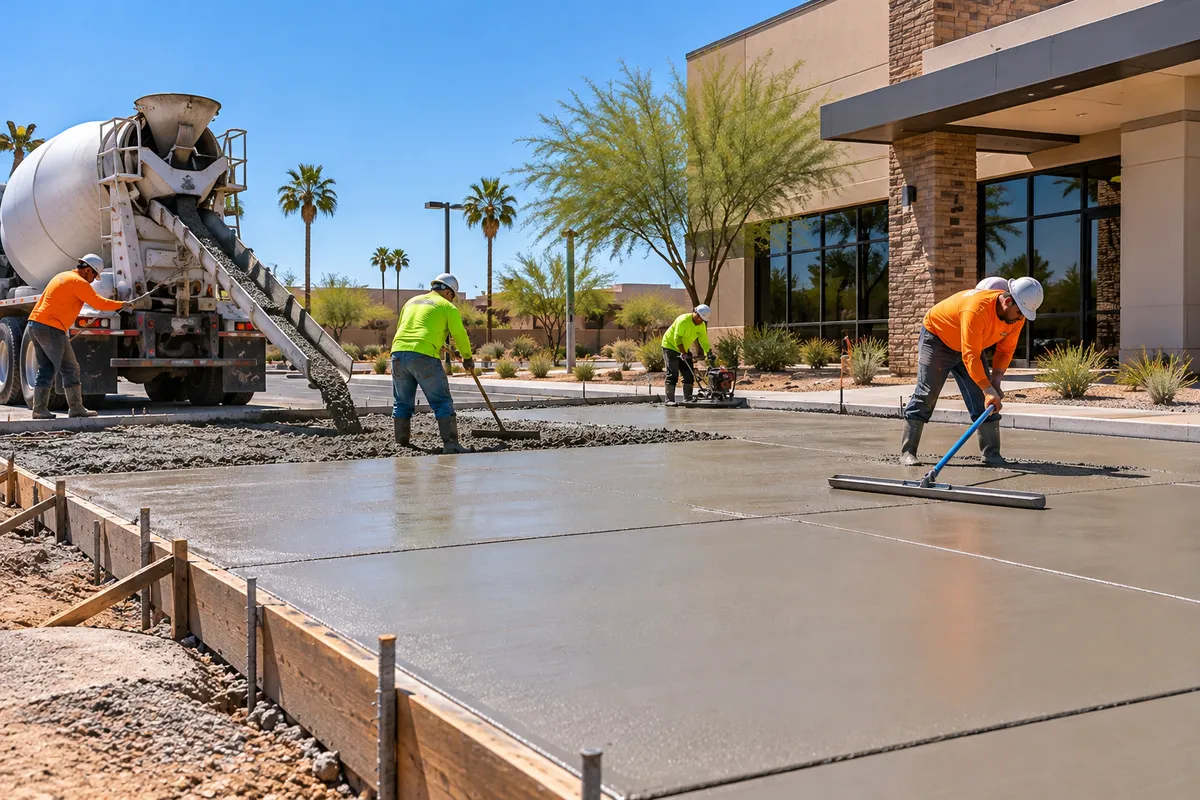
Concrete placement is the most visible stage of paving installation, but it is only one component of the overall schedule. Once the concrete is delivered, the crew must place it, consolidate it as appropriate, establish the finished elevations, and complete the specified surface texture.
The amount of time required varies with the volume of concrete, access to the site, placement equipment, crew size, pavement geometry, and finishing requirements. A straightforward section may be placed relatively quickly, while a complicated layout or a large area requiring several pours may require a staged approach.
Arizona's hot and dry conditions make preparation especially important. Concrete temperature, wind, humidity, and direct sunlight can affect workability, evaporation, and finishing time. Crews must have the necessary labor, equipment, and curing materials ready so the concrete can be placed and protected appropriately without avoidable interruptions.
Stage 5: Jointing, Curing, and Protection
After placement and finishing, the concrete must receive the specified curing treatment and protection. Curing helps maintain the moisture and temperature conditions needed for cement hydration and strength development. The process is particularly important during hot weather, when exposed surfaces can lose moisture rapidly.
Concrete joints are also important because they help accommodate volume changes and manage where cracking is likely to occur. Depending on the project, joints may be formed or saw-cut at specified times, and the site may need to remain protected while this work is completed.
The pavement should not be opened to traffic simply because its surface appears hard. The required waiting period depends on the concrete, environmental conditions, project specifications, and intended loading. For commercial paving, the applicable documents may establish specific strength or testing criteria for reopening the area.
How Does Tempe's Weather Affect Concrete Paving Timelines?
Tempe's desert climate can influence both construction productivity and curing requirements. High temperatures, low humidity, wind, and direct sunlight can accelerate moisture loss from freshly placed concrete and make the material more difficult to place and finish within the desired working period.
During hot weather, contractors may schedule placement during cooler hours, coordinate concrete deliveries, prepare the site before the truck arrives, and arrange for prompt curing. These measures can help reduce avoidable interruptions while protecting fresh concrete from excessive evaporation.
Summer conditions can also affect the timing of excavation, grading, equipment operation, and other outdoor work. A contractor may need to adjust crew hours or organize the work sequence to manage heat exposure while maintaining the quality of the installation.
Monsoon weather introduces a different type of scheduling concern. Heavy rainfall can affect excavation, base preparation, site access, drainage, and freshly placed concrete. Rainfall can also expose problems with temporary water management before the permanent pavement is finished.
Weather does not automatically prevent concrete paving during a particular season, but the installation plan should account for the actual conditions forecast for the project. A schedule that includes appropriate curing and weather protection is more useful than one that promises a fixed completion date without considering the jobsite environment.
How Long Should You Wait Before Using New Concrete Pavement?
The date the contractor finishes placing concrete and the date the pavement can reopen are two different milestones. Fresh concrete continues gaining strength after it has hardened, and its readiness for use depends on the loads it must carry.
Light pedestrian access, passenger vehicles, delivery trucks, and industrial equipment do not place the same demands on a paved surface. A schedule appropriate for a residential area may be inadequate for a commercial loading zone or a pavement designed to support heavy vehicles.
For that reason, property owners should ask the contractor to distinguish between completion of the physical installation and permission to use the finished surface. The opening date should follow the applicable construction specifications, the concrete's strength requirements, and any required test results rather than a general calendar estimate.
Until the pavement is released for use, vehicles and equipment should remain outside the restricted area. Early loading can damage concrete that has not developed sufficient strength, potentially resulting in cracking, edge damage, or other premature deterioration.
For business owners, planning this restriction in advance helps reduce disruption. Temporary parking, alternate vehicle routes, delivery arrangements, and a phased construction sequence can help maintain operations while the concrete develops the required properties.
Can Concrete Paving Be Installed in Phases to Reduce Business Disruptions?
Phased construction may be useful when a commercial property must remain accessible during paving. Instead of closing the entire parking area or paved yard at once, the project may be divided into sections so some areas remain available while others are under construction.
The feasibility of this approach depends on the site layout, access requirements, drainage, construction equipment, and concrete placement plan. The contractor must ensure that separate phases can be completed without compromising the pavement design or creating unsafe transitions between unfinished and finished areas.
Business owners should also consider where customers, employees, deliveries, and emergency access will be directed while work is underway. Temporary traffic controls and clearly marked restrictions can help prevent people from entering areas where excavation, concrete placement, or curing is in progress.
Although phased installation can help preserve access, it may add coordination requirements and affect the overall schedule. The best approach is to discuss operational needs before the estimate is finalized so that the construction sequence reflects the property's requirements.
Do Permits Affect Concrete Paving Installation Time in Tempe, AZ?
Permit and approval requirements depend on the project location and scope. Concrete paving entirely within private property may be subject to different requirements from work that modifies a driveway approach, sidewalk, curb, or public right-of-way.
The City of Tempe Permit Center provides information about building permits and development review. The city also explains that work affecting public streets and right-of-way can require additional authorization through its transportation and right-of-way permit information.
Before setting a construction date, property owners should confirm which approvals apply to the proposed work. If plans, reviews, inspections, or right-of-way permissions are required, the schedule should account for those steps before demolition or placement begins.
The contractor's written proposal should clarify the expected scope and identify who is responsible for coordinating applicable permits and inspections. Establishing these responsibilities early can help prevent avoidable delays and confusion during construction.
What Should You Ask a Concrete Paving Contractor About the Schedule?
A useful paving estimate should explain the major stages of construction and establish realistic expectations for the work. Property owners should ask when site preparation is expected to begin, how long demolition and grading may take, when concrete placement is planned, and how the contractor will protect the finished pavement during curing.
It is also important to identify schedule dependencies. Permit approval, utility coordination, material availability, weather, inspection results, and unexpected soil conditions can affect the start or completion date. The contractor should explain how significant changes will be communicated and what happens if a planned pour must be postponed.
For commercial paving, ask whether the work can be completed in phases and how much of the property will be unavailable at each stage. The proposal should also address cleanup, access restrictions, traffic control where applicable, and the criteria used to determine when the pavement can reopen.
Comparing estimates with similar scopes helps property owners evaluate the proposed schedules more accurately. An unrealistically short timeline may omit important preparation, curing, testing, or approval requirements that are necessary for a successful installation.
Why Consider Ares & Eros Contracting for Concrete Paving in Tempe?
Ares & Eros Contracting provides concrete construction services in Tempe, including commercial paving, driveways, slabs, sidewalks, curbs, and foundations. Its published services address residential, commercial, and municipal applications, which can involve different access, loading, and construction requirements.
Concrete paving requires coordination between site preparation, grading, drainage, placement, jointing, finishing, and curing. Arizona's extreme heat and seasonal rainfall make it important to consider jobsite conditions when establishing the installation sequence and protecting freshly placed concrete.
Property owners and project managers can review AAE's concrete construction services to learn more about its published capabilities. Before selecting a contractor, it is useful to discuss the intended pavement use, site conditions, scheduling requirements, and any restrictions that may affect construction.
Planning Your Concrete Paving Project in Tempe in 2026
A realistic concrete paving schedule considers the full project rather than counting only the hours spent placing concrete. Site evaluation, preparation, forming, reinforcement, placement, finishing, curing, and any required approvals all contribute to the time needed before the paved area is ready for its intended use.
Smaller, uncomplicated projects may require only a few working days of active construction, while larger commercial projects can involve multiple phases and longer periods of restricted access. The actual schedule should be based on the dimensions, construction details, site conditions, and operational requirements of the property.
Property owners can improve planning by requesting a written schedule that separates preconstruction activities, installation, and the criteria for reopening the pavement. This provides a clearer basis for coordinating parking, deliveries, and other activities affected by the work.
Planning concrete paving in Tempe, AZ? Contact Ares & Eros Contracting to discuss your project requirements and request a project-specific estimate.
Frequently Asked Questions About Concrete Paving Installation in Tempe, AZ
Can a concrete paving project be completed in one day?
A small, straightforward concrete placement may be possible within one working day, but the complete project can require additional time for demolition, grading, base preparation, forming, and curing. The contractor should establish the expected schedule after evaluating the site and the scope of work.
Does concrete paving installation include the curing period?
An installation estimate may include the work needed to apply the specified curing method and protect the pavement, but the curing period continues after the crew finishes placing the concrete. Property owners should confirm both the expected construction completion date and the requirements for reopening the surface.
What happens if the ground is not ready when the concrete truck arrives?
The contractor may need to delay placement until the subgrade, base, forms, reinforcement, and required inspections are ready. Pouring before the site is properly prepared can increase the risk of construction problems, so the delivery schedule should be coordinated with actual jobsite readiness.
Can commercial paving be installed without closing the entire parking lot?
In some cases, the work can be divided into sections to preserve access to part of the property. Whether phasing is practical depends on traffic circulation, available space, construction equipment, drainage, and the proposed pavement design.
Does summer heat always make concrete paving take longer?
Not necessarily, but high temperatures and rapid evaporation can reduce finishing time and make curing protection more demanding. A contractor may adjust placement hours and site preparation to manage these conditions, while unsuitable weather can still require a postponement.
When should heavy vehicles be allowed onto new concrete pavement?
Heavy vehicles should not use the pavement until it meets the applicable project requirements. The correct opening time depends on concrete strength, thickness, design, environmental conditions, and the loads involved, so heavy commercial or industrial traffic may require specific strength verification.
Can permit delays change my scheduled paving date?
Yes. If the work requires municipal approval, an engineering review, or authorization for activity in the public right-of-way, those steps may affect when construction can start. Confirming the applicable requirements before scheduling concrete delivery helps reduce avoidable delays.
What should be included in a concrete paving schedule?
A useful schedule should address site preparation, demolition if needed, base installation, forming, concrete placement, finishing, curing, inspections where applicable, and the conditions for reopening the area. It should also identify important dependencies such as weather, approvals, utility coordination, and access restrictions.
Request a Concrete Paving Estimate in Tempe, AZ
Concrete paving is an investment in a property's access, parking, and daily functionality. Establishing a realistic installation schedule helps property owners plan around construction activity while allowing the contractor to complete the necessary preparation, placement, and curing work.
Ares & Eros Contracting provides concrete paving and related concrete construction services throughout Arizona. Homeowners, commercial property managers, developers, and general contractors can discuss their site conditions and scheduling needs before determining the appropriate scope.
Ready to plan concrete paving in Tempe, AZ? Contact AAE to discuss your project and request a concrete construction estimate.
